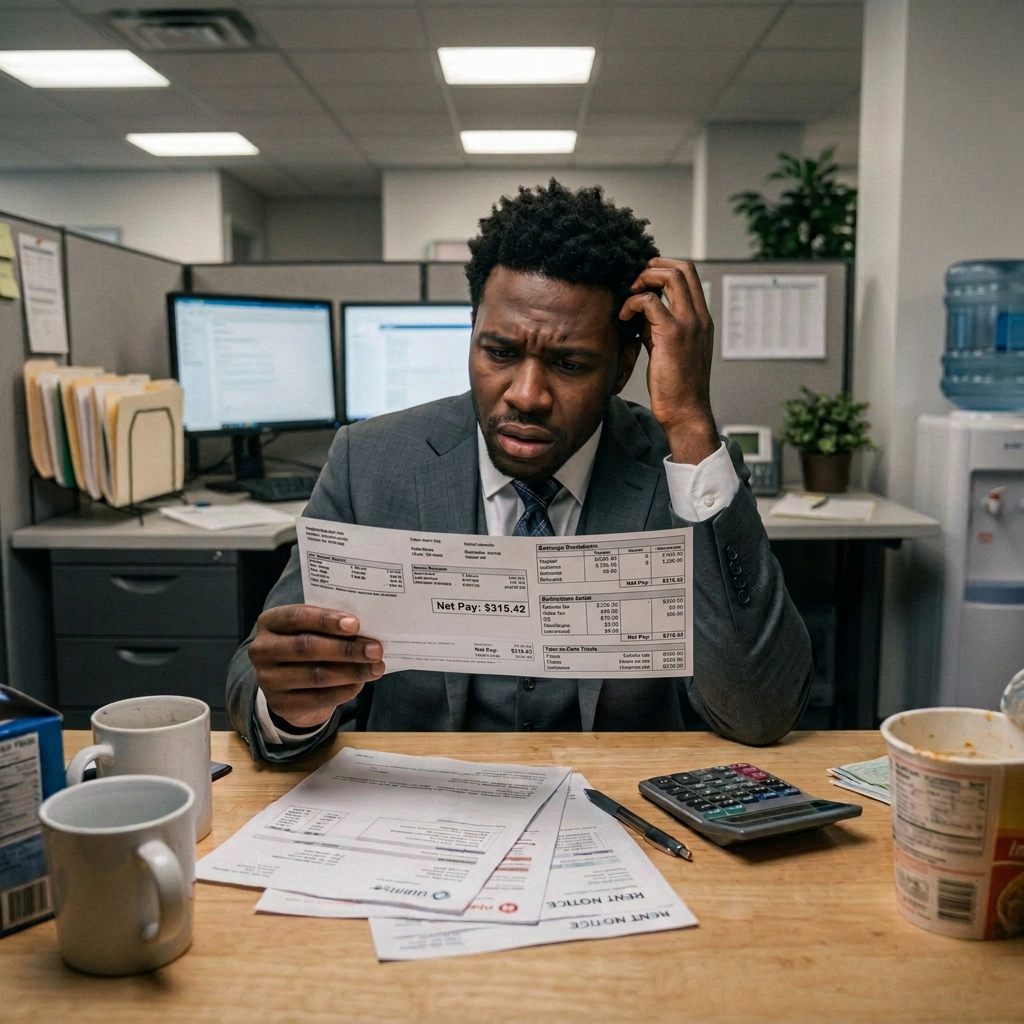

Why Is My Paycheck So Small? Common Reasons Your Take-Home Pay Decreased
Getting a paycheck that is much smaller than you expected can be frustrating, especially when your hourly rate or salary has not changed.
The good news is that a smaller paycheck does not necessarily mean your employer made a mistake. Your gross pay is not the same as your take-home pay. Taxes, insurance premiums, retirement contributions, wage garnishments, and other deductions can significantly reduce the amount that actually reaches your bank account.
However, there are situations where money may have been improperly deducted from your wages.
Here are some of the most common reasons your paycheck may be smaller than expected—and what you can do about it.
Table of Contents
Check Your Gross Pay
Before looking at deductions, compare your current paycheck with your previous paycheck.
Your gross pay is the amount you earned before deductions. Your net pay, or take-home pay, is what remains after taxes and other deductions are taken out.
Your gross pay can decrease if:
- You worked fewer hours.
- You took unpaid time off.
- Your hourly rate changed.
- You received less overtime.
- A bonus, commission, or other additional payment was included in an earlier paycheck but not this one.
- Your employer made an error in calculating your hours or wages.
- Your pay period was different from what you expected.
If your gross pay is lower, the problem may not be your deductions at all.
If your gross pay is about the same but your net pay is significantly lower, look closely at the deductions section of your pay stub.
1. Federal Income Tax Was Withheld
Federal income tax is normally withheld from an employee’s paycheck.
The amount withheld depends in part on how much you earn and the information you provided on Form W-4. Your filing status, multiple jobs, dependents, other income, deductions, and additional withholding can affect the amount withheld.
This means two employees earning the same gross amount can have different take-home pay.
If your federal income tax withholding suddenly increased, check your W-4 and compare it with your previous paychecks.
You can also use the IRS Tax Withholding Estimator to determine whether your withholding is generally on track.
2. Social Security and Medicare Taxes Were Deducted
Most employees also have Social Security and Medicare taxes withheld from their pay.
These are employment taxes that employers generally must withhold from employee wages.
You may therefore see separate deductions on your paycheck for:
- Social Security
- Medicare
These deductions reduce your take-home pay even though your gross wages remain the same.
3. State or Local Taxes Were Withheld
Depending on where you work and live, your paycheck may also include state and local income tax withholding.
Some states and localities impose income taxes, while others do not.
If you recently moved, changed jobs, changed your work location, or changed your tax withholding information, the amount withheld may be different from what you were accustomed to seeing.
4. Your Health Insurance Premium Increased
Health insurance is another common reason a paycheck can suddenly become smaller.
If your employer-sponsored health insurance premium increased, your share of the cost may have increased as well.
Look at the deductions on your current pay stub and compare them with an earlier paycheck. You may see deductions labeled something like:
- Medical
- Dental
- Vision
- Health insurance
- Flexible spending account
- Health savings account
A benefits change during open enrollment can also cause your take-home pay to change.
5. You Increased Your Retirement Contribution
Contributing more to a 401(k) or another retirement plan can reduce your take-home pay.
For example, if you increased your retirement contribution from 5% to 10%, more of your paycheck may go toward retirement and less will be deposited into your bank account.
This does not necessarily mean you are earning less. It means more of your compensation is being directed toward your retirement account.
6. You Have a Wage Garnishment
A wage garnishment can substantially reduce the amount of money you receive in your paycheck.
A garnishment is a legal process that requires an employer to withhold part of an employee’s earnings to satisfy certain debts or obligations. Child support is one example.
Federal law limits the amount that can generally be garnished from disposable earnings for covered debts, although different rules apply to certain obligations, including some tax debts and bankruptcy orders. State law may provide additional protections.
If you see a new garnishment deduction that you do not recognize, do not simply assume it is an employer mistake. Find out what order or legal process caused the deduction.
7. You Have Other Voluntary Deductions
Your paycheck may include deductions you previously authorized.
Examples can include:
- Retirement contributions
- Health insurance
- Dental insurance
- Vision insurance
- Flexible spending accounts
- Certain charitable contributions
- Union dues
- Other employee benefits
Some deductions are voluntary, while others are required by law or authorized through another legal process.
Check your pay stub to determine exactly what has been deducted.
8. You Received Less Overtime Pay
If you normally work overtime, your paycheck can feel dramatically smaller when you work fewer overtime hours.
Under the federal Fair Labor Standards Act, covered, nonexempt employees generally must receive overtime pay at one and one-half times their regular rate for hours worked over 40 in a workweek. Some employees are exempt from federal overtime requirements, and state law may provide additional protections.
Remember that overtime is generally calculated based on the workweek—not simply the number of hours shown on a particular paycheck.
If you believe your paycheck is missing overtime pay, compare your time records with the hours and overtime listed on your pay stub.
9. Your Employer Made a Payroll Error
Sometimes the simplest explanation is that payroll made a mistake.
Examples include:
- Missing hours
- Incorrect hourly rate
- Missing overtime
- Incorrect commission
- Missing bonus
- Incorrect deduction
- Duplicate deduction
- Incorrect benefit deduction
- Incorrect tax withholding
- Unpaid work time
Do not assume that every difference is a normal deduction.
If your gross wages are incorrect, bring the discrepancy to your employer or payroll department promptly.
10. Your Employer Deducted Money for a Work-Related Expense
This is where a smaller paycheck can become an employment-law issue.
Federal law places restrictions on certain deductions from wages. For example, under the Fair Labor Standards Act, deductions for items such as required uniforms, tools, cash shortages, or other employer-related expenses cannot reduce an employee’s wages below the required minimum wage or cut into overtime compensation when the FLSA applies.
For example, an employer generally cannot simply deduct the cost of a required uniform from a worker’s wages in a way that causes the employee to fall below the applicable federal minimum wage or reduces required overtime compensation.
State laws may impose additional restrictions on paycheck deductions.
Is It Legal for My Employer to Deduct Money From My Paycheck?
Not every deduction is illegal.
Employers generally make many lawful deductions, including required taxes and authorized benefit deductions.
The important questions are what was deducted, why it was deducted, and what federal and state laws apply to the employee’s situation.
The FLSA does not regulate every type of paycheck deduction. Some wage-payment and deduction issues are primarily governed by state law or other federal laws.
For that reason, a deduction that is lawful in one situation or jurisdiction may not be lawful in another.
What Should I Do If My Paycheck Is Smaller Than Expected?
Start by comparing your current pay stub with a previous one.
Look at:
- Gross pay: Did you earn less money before deductions?
- Hours worked: Are all of your hours listed?
- Overtime: Is all qualifying overtime included?
- Tax withholding: Did federal, state, or local withholding change?
- Benefits: Did an insurance or other benefit deduction increase?
- Retirement contributions: Did your contribution percentage change?
- Garnishments: Is there a new legal deduction?
- Other deductions: Is there something you do not recognize?
If you find an unfamiliar deduction, ask your employer or payroll department to explain it.
Keep copies of your pay stubs and your own records of hours worked.
What If My Employer Won’t Explain the Deduction?
If your employer cannot explain a deduction or you believe your wages were improperly reduced, document the problem.
Keep:
- Pay stubs
- Time records
- Employment agreements
- Written payroll communications
- Benefit enrollment information
- Records of deductions
- Any messages from your employer concerning your pay
Then determine whether the issue involves federal law, state wage law, a wage garnishment, taxes, benefits, or another issue.
For Fair Labor Standards Act minimum-wage and overtime issues, the U.S. Department of Labor’s Wage and Hour Division may be able to provide information about federal wage protections.
For state-specific wage deductions, you may need to contact your state’s labor or employment agency.
Can My Employer Take Money From My Paycheck Without Telling Me?
Whether an employer can make a particular deduction without your authorization or notice depends on the type of deduction and applicable law.
Some deductions are required by law, such as certain taxes. Others may be authorized through benefit programs, retirement plans, court orders, or other legal arrangements.
Other deductions may be restricted or prohibited.
Because state wage laws vary, it is important to look at the specific deduction rather than assuming that all paycheck deductions are treated the same way.
Why Is My Paycheck Smaller Even Though My Salary Did Not Change?
Your salary can remain exactly the same while your take-home pay changes.
For example, your net paycheck could decrease because:
- Federal tax withholding increased.
- State tax withholding increased.
- Your health insurance became more expensive.
- You increased your retirement contribution.
- A garnishment began.
- Another benefit deduction was added.
- Your W-4 information changed.
- A previously temporary deduction became ongoing.
In other words, a smaller paycheck does not necessarily mean a smaller salary.
The key is to compare the gross pay and each individual deduction.
When a Small Paycheck May Be a Legal Problem
A smaller paycheck deserves closer attention when the numbers do not match the work you actually performed.
You may have a potential wage issue if:
- Your employer failed to pay you for hours you worked.
- Your employer failed to pay required overtime.
- Your employer deducted money in a way that violates applicable wage laws.
- Your employer withheld wages for a work-related expense in violation of applicable law.
- Your paycheck contains an unexplained deduction.
- Your employer paid you less than the required minimum wage.
- Your employer made an unauthorized or otherwise unlawful deduction.
Federal and state laws can differ, so the fact that an employer calls something a “deduction” does not automatically make it legal.
The Bottom Line: Why Is My Paycheck So Small?
If your paycheck is smaller than expected, don’t immediately assume that your employer shorted you.
First, compare your gross pay and deductions with a previous paycheck. Taxes, insurance, retirement contributions, garnishments, and other legitimate deductions can all reduce your take-home pay.
But if your gross wages are wrong, hours are missing, overtime was not paid, or an unfamiliar deduction appears on your paycheck, you should investigate further.
The most important thing is to find out exactly where the missing money went. Once you identify the deduction or payroll difference, you can determine whether it is a normal payroll deduction, a tax or benefit issue, or a potential wage-law violation.
See our Employee Rights resources and Wage Theft & Unpaid Wages hub for more information about paycheck and wage problems.
Related Articles
You may also find these articles helpful:
- What Should I Do If My Paycheck Is Wrong
- Not Getting Paid on Time
- Can Your Employer Deduct Money From Your Paycheck?
- Can Your Employer Make You Work Through Lunch?
- Can Your Employer Make You Work on Your Day Off?
For more information about your rights regarding wages and pay, visit our Wage Theft & Unpaid Wages hub.
Disclaimer
This article provides general information about U.S. employment law and is not legal advice. Employment laws vary by state, and the law applicable to your situation may depend on the specific facts. If you believe your employer has unlawfully withheld wages, consider speaking with an employment attorney or contacting the appropriate government agency. Please read our Terms and Conditions.
Article: Why Is My Paycheck So Small?
Discover more from Worker Wisdom℠
Subscribe to get the latest posts sent to your email.