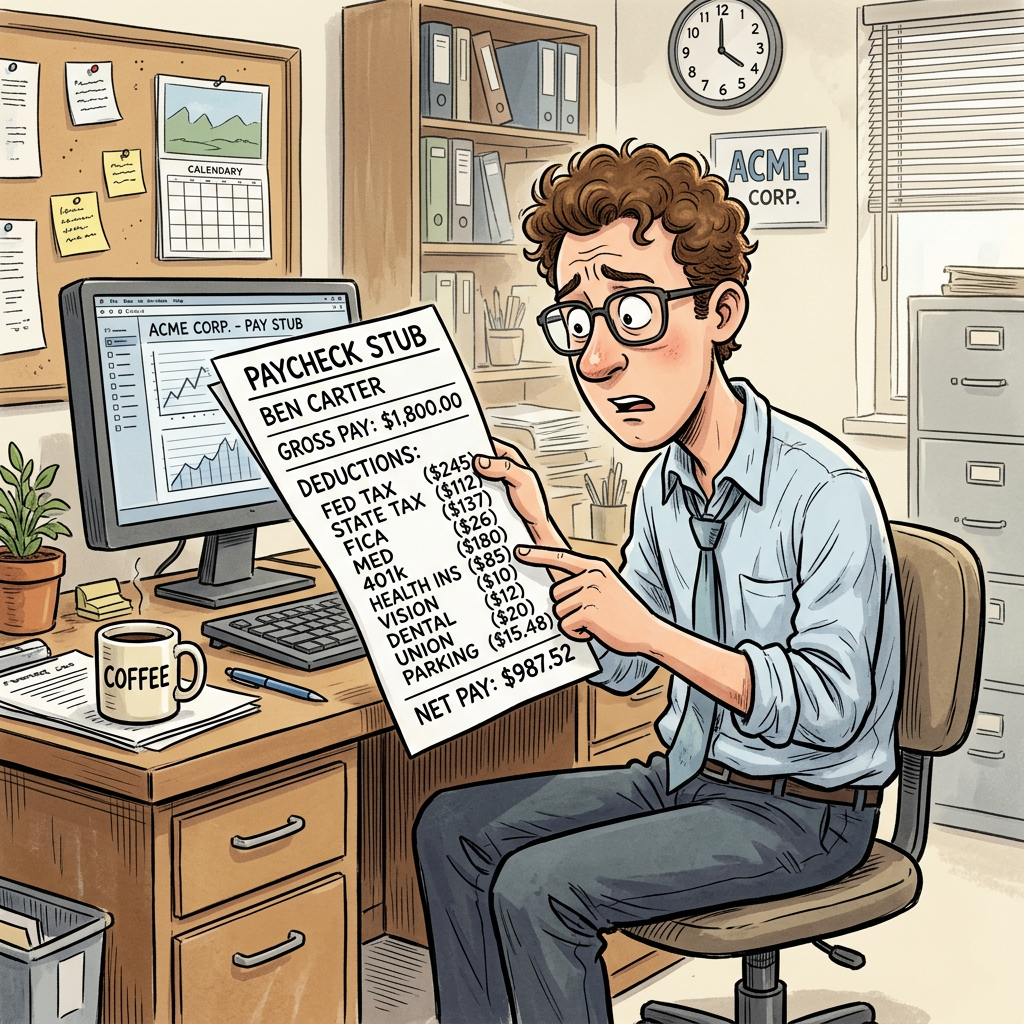

Seeing your paycheck come in lower than expected can be frustrating—especially when you discover that your employer deducted money for something you did not expect to pay for.
So, can your employer legally take money from your paycheck?
Sometimes. But employers cannot simply deduct whatever they want.
Federal law, state law, and sometimes your employment agreement or company policies can all affect whether a paycheck deduction is legal. Some deductions are routine and required by law, while others generally require your authorization or are subject to restrictions.
Here is what employees should know about paycheck deductions.
For more information on pay and benefits check out our Pay & Benefits hub.
Table of Contents
What Is a Paycheck Deduction?
A paycheck deduction is money withheld from your wages before you receive your paycheck.
Some deductions are required by law. Others are voluntary or are made because you owe money to your employer or have agreed to pay for a particular benefit or service.
Common paycheck deductions include:
- Federal income taxes
- Social Security and Medicare taxes
- State and local taxes
- Health insurance premiums
- Retirement contributions
- Union dues
- Charitable contributions
- Wage garnishments
- Repayment of certain loans
- Other employee-authorized deductions
The fact that an employer has taken money from your paycheck does not automatically mean the deduction is legal.
What Deductions Can an Employer Legally Make?
There is no single federal rule that makes every paycheck deduction legal or illegal. The answer depends on the type of deduction and the laws that apply to your employment.
Taxes and Other Legally Required Deductions
Employers generally must withhold certain taxes from employees’ paychecks.
These can include:
- Federal income tax
- Social Security tax
- Medicare tax
- Applicable state income taxes
- Certain local taxes
Employers may also be required to withhold money pursuant to a valid court order or other legal process.
For example, a wage garnishment may require an employer to withhold part of an employee’s wages to satisfy a debt.
Benefits You Have Authorized
Employers commonly deduct money for benefits that employees have agreed to pay for.
Examples may include:
- Health insurance
- Dental insurance
- Vision insurance
- Retirement contributions
- Certain flexible spending accounts
- Union dues
- Other employee benefits
Whether a particular deduction is permitted can depend on state law and whether the employee properly authorized it.
Can Your Employer Deduct Money for a Mistake?
This is where the rules can become more complicated.
Suppose your employer accidentally overpaid you by $500. Can the employer simply take $500 from your next paycheck?
Not necessarily.
State laws can impose restrictions on recovering overpayments. An employer may have to follow specific procedures, provide notice, or obtain authorization before making certain deductions.
The rules vary considerably from state to state.
Employees should therefore check their state’s wage laws before assuming that an employer can automatically recover an overpayment from a future paycheck.
Can Your Employer Deduct Money for a Cash Shortage?
Employers sometimes try to deduct money from an employee’s paycheck when a cash register is short.
For example, suppose you work as a cashier and your register is $75 short at the end of your shift. Your employer might tell you that the $75 will come out of your paycheck.
Federal law places important limits on this practice.
Under the Fair Labor Standards Act (FLSA), a deduction for a cash shortage cannot reduce a covered, nonexempt employee’s wages below the applicable minimum wage or reduce required overtime compensation. The Department of Labor specifically identifies cash and merchandise shortages as deductions that can violate the FLSA when they have that effect.
So even if an employer has a policy saying employees are responsible for shortages, that policy does not override federal wage-and-hour requirements.
State law may provide additional protections.
Can Your Employer Deduct Money for Broken Equipment?
Employers sometimes try to make employees pay for damaged equipment, merchandise, tools, or other property.
Again, federal law can limit these deductions.
The U.S. Department of Labor explains that deductions for items primarily benefiting the employer—such as tools used for the job or damage to the employer’s property—cannot reduce a covered employee’s wages below the federal minimum wage or required overtime compensation.
For example, an employer generally cannot avoid minimum-wage requirements by simply deducting the cost of damaged equipment from an employee’s paycheck.
State laws may impose even stricter restrictions.
Can Your Employer Deduct Money for a Uniform?
Uniform deductions are another area where employees sometimes encounter problems.
An employer may be able to require employees to pay for certain uniforms or clothing under some circumstances. However, the deduction cannot violate applicable minimum-wage or overtime requirements.
The Department of Labor specifically states that deductions for required uniforms cannot reduce an employee’s wages below the federal minimum wage or cut into required overtime compensation.
Whether an employer can make the deduction at all may also depend on state law.
Can Your Employer Deduct Money for a Loan?
If your employer loaned you money, the employer may be able to deduct payments from your paycheck—but state law may require your authorization.
For example, Pennsylvania generally requires written authorization for certain non-tax-related deductions. Pennsylvania’s Department of Labor & Industry states that an employee must give written authorization for certain deductions, including repayment of an employer loan.
The exact rules depend on the state where you work.
Can Your Employer Deduct Money Without Your Permission?
Sometimes.
Your employer does not necessarily need your permission to make every deduction. Taxes and certain court-ordered deductions, for example, can be required by law.
But many other deductions require employee authorization, and some deductions are restricted regardless of whether an employee agrees to them.
This is an important distinction:
Signing an agreement does not necessarily make an otherwise illegal deduction legal.
For example, federal wage law can still prohibit certain deductions if they cause a covered employee’s wages to fall below the applicable minimum wage or reduce required overtime pay.
State law may provide additional protections.
Can Your Employer Take Money From Your Paycheck for Being Late?
This depends on what the employer is doing.
An employer generally can have a policy requiring employees to clock in on time. It may also discipline employees who repeatedly arrive late.
But there is a major difference between not paying an employee for time they did not work and deducting money from wages the employee already earned.
For example, if you were scheduled to work from 9:00 a.m. to 5:00 p.m. but arrived at 9:15, the employer generally does not have to pay you for 15 minutes you did not work.
That does not automatically mean the employer can impose an arbitrary $50 deduction from your paycheck as a punishment.
State wage laws can be particularly important when an employer calls something a “fine” or “penalty.”
The same issue can arise when employees are required to work during unpaid breaks. See [Can Your Employer Make You Work Through Lunch?] for more information about when employers must pay employees for working through a break.
Can Your Employer Deduct Money as a Punishment?
This can be legally problematic.
Employers may have the right to discipline employees for violating workplace rules. Depending on the circumstances, discipline can include warnings, suspension, or termination.
But taking earned wages as a punishment is a different issue.
Whether a particular deduction is permissible depends on applicable federal and state law. Some states have particularly strict rules governing deductions and wage penalties.
If an employer says, for example, “You broke the company rule, so we’re taking $100 out of your paycheck,” do not automatically assume the deduction is legal.
What About Wage Garnishment?
A wage garnishment is different from an ordinary employer deduction.
A garnishment generally occurs because a government agency, court, or other authorized legal process requires an employer to withhold money from an employee’s wages.
Depending on the type of debt, garnishments can involve:
- Child support
- Certain taxes
- Student loans
- Court judgments
- Other legally enforceable debts
The employer generally does not get to decide on its own that an employee owes money and begin withholding wages as though it were a garnishment.
The employer must generally have appropriate legal authority to make the withholding.
What If Your Employer Deducts More Than You Agreed To?
If you authorized a deduction, that does not necessarily give your employer unlimited authority to take whatever amount it wants.
Pay attention to:
- What you agreed to
- How much you agreed to pay
- Whether the authorization was in writing
- Whether the deduction is for your benefit
- Whether state law imposes additional requirements
- Whether the deduction affects minimum-wage or overtime requirements
If the amount deducted is different from what you authorized, ask your employer or payroll department for an explanation.
Keep a copy of the authorization and your pay stub.
What If Your Paycheck Is Short?
If you believe your employer made an improper deduction, start by reviewing your paycheck carefully.
1. Check Your Pay Stub
Look for:
- The amount of wages earned
- Hours worked
- Overtime
- Taxes
- Benefit deductions
- Other deductions
- The final amount paid to you
Compare the pay stub with previous paychecks.
2. Ask Payroll for an Explanation
Sometimes a deduction is simply a mistake.
Ask payroll or your human resources department what the deduction was for and why it was taken.
If possible, make the request in writing so you have a record.
3. Review Your Employee Documents
Look at:
- Your employment agreement
- Employee handbook
- Benefits documents
- Payroll authorization forms
- Any loan agreement
- Written policies concerning deductions
4. Check Your State’s Law
Federal law establishes certain minimum protections, but states can provide additional protections concerning paycheck deductions.
That means a deduction that is permissible under federal law could still violate state law.
5. Consider Filing a Wage Complaint
If you believe your employer has improperly withheld wages, you may be able to file a complaint with the appropriate state labor agency or the U.S. Department of Labor.
What Should You Do If You Think a Deduction Is Illegal?
If money was taken from your paycheck and you believe the deduction was improper, don’t ignore it.
Start by documenting what happened.
Keep copies of:
- Your pay stubs
- Time records
- Employment agreements
- Employee handbook provisions
- Payroll deduction authorizations
- Emails and text messages
- Written notices about the deduction
- Any communications with your employer about the issue
Then determine what law applies to your situation.
Depending on the circumstances, you may be able to contact:
- Your state labor department
- The U.S. Department of Labor
- An employment attorney
The appropriate agency can depend on the type of deduction and the law involved.
The Bottom Line
Can your employer deduct money from your paycheck? Yes—but not for just any reason.
Taxes and certain legally required withholdings can generally be taken without your permission. Other deductions, such as benefit contributions or loan repayments, may require authorization.
Deductions for things such as cash shortages, damaged employer property, required uniforms, or work-related tools can also be restricted by federal and state wage laws—particularly when the deduction reduces your wages below the applicable minimum wage or cuts into required overtime pay.
If an unexpected deduction appears on your paycheck, don’t assume that it is legal simply because your employer made it. Check what the deduction was for, whether you authorized it, and what federal and state law says about it.
Your employer cannot simply take earned wages because it wants to.
Frequently Asked Questions
Can my employer deduct money from my paycheck without telling me?
It depends on the type of deduction and applicable law. Taxes and certain legally required deductions may be made without individual authorization. Other deductions may require notice or written authorization under state law.
Can an employer deduct money for a cash register shortage?
Federal law restricts deductions for cash shortages when they reduce a covered employee’s wages below the applicable minimum wage or reduce required overtime pay. State law may provide additional protections.
Can my employer deduct money for damaged equipment?
Federal wage law can restrict deductions for employer property or equipment when the deduction reduces a covered employee’s wages below the applicable minimum wage or required overtime compensation.
Can my employer deduct money for a uniform?
Potentially, but federal law restricts deductions for required uniforms when they reduce a covered employee’s wages below the applicable minimum wage or required overtime compensation.
Can my employer deduct money from my final paycheck?
Sometimes, but final-paycheck deductions are subject to applicable federal and state laws. State wage-payment laws can be particularly important when an employer attempts to deduct money from an employee’s final wages.
What should I do if my employer took money from my paycheck illegally?
Save your pay stub and other relevant records, ask the employer for an explanation, and review your state’s wage laws. You may also be able to file a wage complaint with a state labor agency or the U.S. Department of Labor, depending on the circumstances.
Disclaimer
This article provides general information about employment and wage laws and is not legal advice. Wage deduction rules vary by state and by the circumstances of the deduction. If you believe your employer has unlawfully withheld wages, consider consulting an employment attorney or the appropriate government labor agency about your specific situation. Please read the terms and conditions.
Related Articles
You may also want to read:
- [Can Your Employer Make You Work Through Lunch?] — Learn when employers are required to pay employees for time spent working during a meal break.
- [Can Your Employer Make You Work on Your Day Off?] — Find out when an employer can require you to work on a scheduled day off and whether you must be paid.
- [Breaks & Lunch Laws] — Understand the federal and state rules that apply to employee breaks, meal periods, and pay.
Article: Can Your Employer Deduct Money From Your Paycheck?
Discover more from Worker Wisdom℠
Subscribe to get the latest posts sent to your email.
Pingback: How Often Does My Employer Have to Pay Me? - Worker Wisdom℠
Pingback: Why Is My Paycheck So Small? Common Reasons Your Take-Home Pay Decreased - Worker Wisdom℠