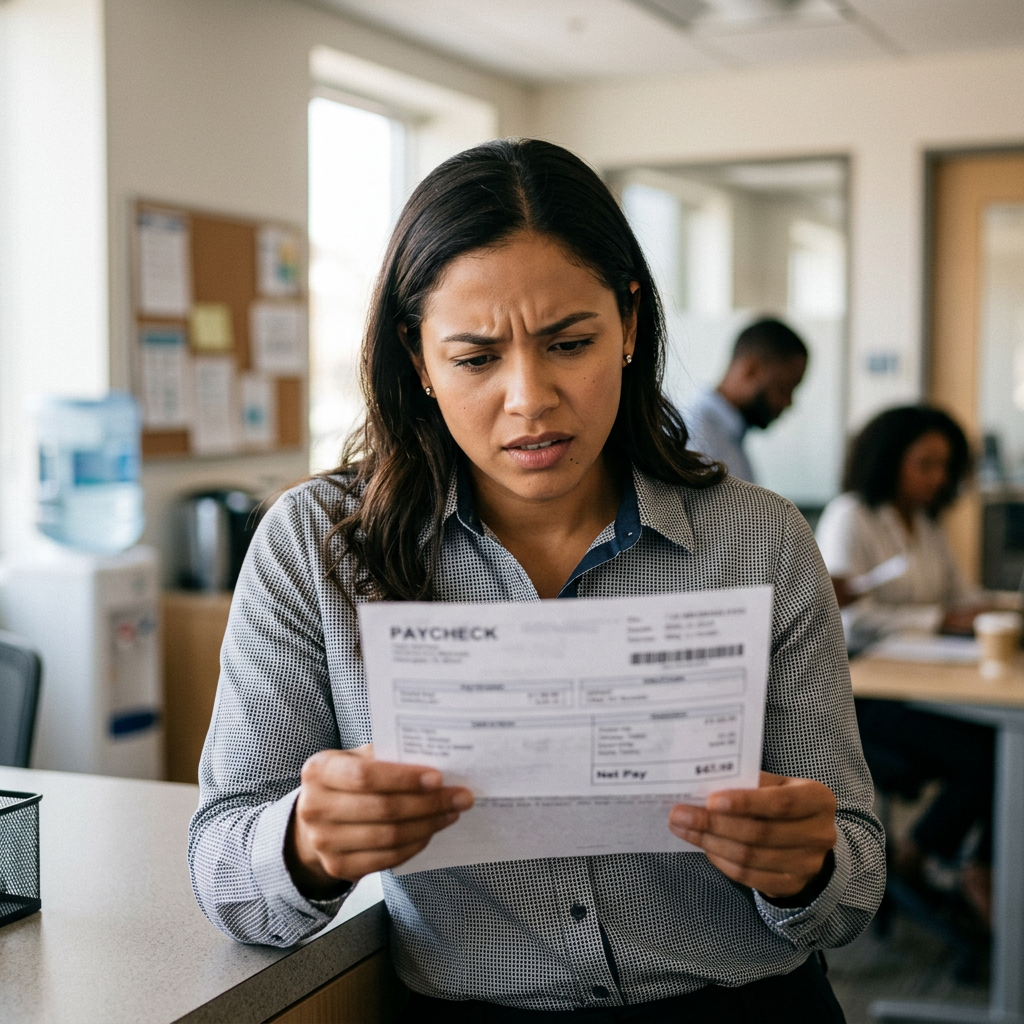

What Should I Do If My Paycheck Is Wrong?
Getting your paycheck and discovering that something is wrong can be frustrating, especially when you rely on that money to pay your bills.
Maybe your paycheck is missing hours you worked. Maybe your hourly rate is incorrect, your overtime is missing, or an unexpected deduction was taken out. You may also notice that a bonus, commission, or other payment you were expecting was not included.
If your paycheck is wrong, do not assume that the mistake will automatically be corrected. Start by reviewing your paystub, comparing it with your own records, and notifying your employer of the problem.
Depending on the type of error, you may also have rights under federal or state wage laws. If the problem isn’t the amount but the fact that the check didn’t clear at all, that’s a different set of rights. See my paycheck bounced.
For more information on payroll and taxes, check out our Payroll & Taxes page.
Table of Contents
What Should I Do If My Paycheck Is Wrong?
If you believe your paycheck is incorrect, take these steps:
- Review your paystub carefully.
- Compare your paycheck with your own records.
- Determine exactly what appears to be wrong.
- Notify your employer or payroll department promptly.
- Keep documentation of the error and your communications.
- Make sure the correction is actually made.
- Consider contacting a labor agency or employment attorney if the problem is not resolved.
The sooner you identify the problem, the easier it may be to determine how much you are owed.
Check Your Paystub
Start by reviewing your paystub line by line.
Depending on your employer and state, your paystub may show information such as:
- Pay period dates
- Hours worked
- Regular hours
- Overtime hours
- Hourly rate
- Salary
- Bonuses
- Commissions
- Gross wages
- Federal income tax withholding
- Social Security tax
- Medicare tax
- State and local taxes
- Health insurance deductions
- Retirement contributions
- Other deductions
- Net pay
Compare these figures with what you expected to receive.
A paycheck can look lower than expected for many legitimate reasons, so it is important to identify the specific error rather than assuming every difference is illegal.
Compare Your Paycheck With Your Records
If you are paid hourly, compare the hours on your paystub with your own records.
For example, check whether:
- Every shift was included.
- Your start and end times were recorded correctly.
- Meal periods were recorded correctly.
- Overtime hours were included.
- Training time was included when required.
- Meetings or required work performed before or after your shift were included.
Your own records can be especially important if your employer’s timekeeping system does not accurately reflect the hours you worked.
Under the Fair Labor Standards Act (FLSA), employers generally must keep records of employees’ wages and hours, and covered nonexempt employees must be paid for compensable time worked.
What If My Employer Left Hours Off My Paycheck?
If you worked hours that are missing from your paycheck, notify your employer as soon as possible.
Give payroll or your manager the specific dates and hours that were not included.
For example, instead of simply saying, “My paycheck is wrong,” you could explain that you worked eight hours on a particular date and those hours are not reflected on your paystub.
Keep a copy of your time records and your communication with the employer.
For covered, nonexempt employees, federal law requires payment of at least the applicable minimum wage for hours worked and generally requires overtime pay for hours worked over 40 in a workweek.
What If My Pay Rate Is Wrong?
Check your paystub against the rate you were supposed to receive.
Your pay rate might be wrong because:
- A promised raise was not applied.
- A new hourly rate was entered incorrectly.
- A promotion was not reflected.
- A contractual rate was not honored.
- Payroll used the wrong rate for a particular pay period.
Whether an employer is legally required to pay a particular promised rate can depend on the circumstances and applicable state law.
However, if the incorrect rate causes a covered employee to receive less than the minimum wage or required overtime compensation, federal wage laws may apply.
State wage laws can also provide additional protections.
What If My Overtime Pay Is Wrong?
If you worked more than 40 hours during a workweek and are covered by the FLSA’s overtime requirements, check whether your overtime was properly calculated.
Generally, covered nonexempt employees must receive overtime at a rate of at least one and one-half times their regular rate for hours worked over 40 in a workweek, unless an exemption applies.
Overtime is calculated by workweek, not simply by the number of hours shown on a biweekly paycheck.
For example, working 45 hours during one workweek and 35 hours during the next does not generally mean that you worked 80 hours with no overtime. The five hours over 40 in the first workweek may qualify as overtime.
What If My Employer Says I Was Not Authorized to Work Overtime?
An employer may have a policy requiring employees to obtain approval before working overtime.
But an employer’s internal policy does not necessarily eliminate its obligation to pay for compensable overtime that an employee actually worked.
The Department of Labor explains that an employer’s announcement that overtime will not be permitted or will not be paid unless authorized in advance does not, by itself, eliminate an employee’s right to compensation for overtime hours that were actually worked.
An employer can generally discipline an employee for violating a workplace policy, but that is a separate issue from whether the employee must be paid for compensable work.
What If a Deduction on My Paycheck Is Wrong?
Review every deduction carefully.
Some deductions are legitimate and may include:
- Federal income tax
- Social Security tax
- Medicare tax
- State or local taxes
- Health insurance premiums
- Retirement contributions
- Wage garnishments
- Other authorized deductions
But not every deduction is automatically legal.
Federal law places restrictions on certain deductions when they would reduce a covered, nonexempt employee’s wages below the required minimum wage or reduce overtime compensation. The Department of Labor specifically identifies deductions involving items such as cash shortages, required uniforms, and tools of the trade as potentially restricted under the FLSA.
State law may provide additional restrictions.
If you do not recognize a deduction, ask your employer what it is and why it was taken.
What If Too Much FICA Tax Was Taken Out?
FICA taxes consist of Social Security and Medicare taxes.
If you believe the wrong amount of Social Security or Medicare tax was withheld, compare the deduction with your wages and the applicable tax rules.
Payroll tax errors can sometimes result from an employer entering incorrect information into its payroll system or failing to properly account for a particular situation.
If you believe FICA taxes were withheld incorrectly, contact your employer or payroll department and ask them to review the withholding.
What If My Bonus or Commission Is Missing?
A missing bonus or commission can be more complicated than a missing hourly wage.
Whether you are legally entitled to a particular bonus or commission may depend on:
- Your employment agreement.
- The employer’s compensation plan.
- The terms under which the payment was earned.
- Company policies.
- Applicable state law.
- Whether the payment is discretionary or promised.
Do not assume that a missing bonus is automatically a payroll error or automatically something your employer is legally required to pay.
Instead, review the terms governing the payment and ask your employer for an explanation.
What If My Employer Says the Error Will Be Fixed on My Next Paycheck?
Sometimes an employer discovers a payroll error and tells the employee that the missing wages will be included in the next paycheck.
Whether that is legally sufficient depends on the type of wage involved and applicable federal and state law.
For example, the FLSA requires covered wages to be paid on the regular payday for the pay period covered. The Department of Labor also states that when overtime compensation cannot be determined until after the regular pay period, the additional overtime generally must be paid as soon as practicable.
State wage-payment laws may impose additional requirements.
If a significant amount of wages is missing, do not assume that you simply have to wait indefinitely for payroll to correct it.
Should I Tell My Employer That My Paycheck Is Wrong?
Yes.
In most situations, the first step should be to give your employer an opportunity to investigate and correct the mistake.
Contact the appropriate person, such as:
- Payroll
- Human resources
- Your manager
- Your supervisor
Be specific about the problem.
Instead of saying:
“My paycheck is wrong.”
Explain:
“My paycheck appears to be missing eight hours from the week of September 1, and my paystub shows 32 hours instead of the 40 hours I worked.”
A specific explanation makes it easier for the employer to investigate the problem.
Keep Records of the Paycheck Error
Keep copies of anything that could help establish what happened.
This can include:
- Paystubs
- Timecards
- Schedules
- Clock-in and clock-out records
- Emails
- Text messages
- Employment agreements
- Compensation plans
- Bonus or commission agreements
- Records of hours worked
- Communications with payroll or management
Do not rely solely on your employer’s payroll system to preserve your records.
Having your own documentation can be especially helpful if the employer disputes how many hours you worked or how much you were supposed to be paid.
What If My Employer Refuses to Correct My Paycheck?
If your employer refuses to correct an apparent wage error, determine whether the problem potentially violates federal or state law.
The FLSA establishes federal minimum wage and overtime requirements, but it does not provide a remedy for every disagreement involving an employee’s promised wages or compensation. Some wage-payment issues are governed primarily by state law.
You may be able to:
- Contact your state labor department.
- Contact the U.S. Department of Labor’s Wage and Hour Division.
- Review your state’s wage-payment laws.
- Consult an employment attorney.
The appropriate option depends on the type of error and the law that applies.
Can My Employer Retaliate Against Me for Asking About My Paycheck?
Employees should not assume that they have no protection simply because they question their pay.
Federal law contains protections against retaliation for certain activities involving wage and hour rights.
For example, the FLSA includes protections for employees who exercise rights protected by the law or participate in certain wage-related proceedings. The specific protection that applies depends on what the employee did and which law is involved.
If you believe your employer retaliated against you after you raised a wage complaint, document what happened, including dates, communications, and any changes to your employment.
How Long Do I Have to Correct a Paycheck Error?
There is no single nationwide deadline that applies to every type of paycheck error.
Different federal and state laws can have different deadlines for bringing wage claims.
For that reason, do not assume that you can wait indefinitely before addressing a paycheck problem.
If your employer does not correct a significant wage error, review the applicable law promptly.
What Should I Do About a Paycheck Error?
If you discover an error, the simplest approach is to work through the problem systematically:
1. Review your paystub.
Identify exactly what appears to be incorrect.
2. Check your records.
Compare the paycheck with your hours, pay rate, overtime, bonuses, commissions, and deductions.
3. Calculate the difference.
Determine approximately how much you believe you are missing.
4. Contact payroll or management.
Explain the problem clearly and provide supporting information.
5. Keep everything in writing.
Save your paystub and communications concerning the error.
6. Check whether the problem was corrected.
Review your next paycheck rather than assuming the issue was fixed.
7. Escalate if necessary.
If your employer refuses to correct a potentially unlawful wage error, consider contacting the appropriate labor agency or an employment attorney.
The Bottom Line: What Should I Do If My Paycheck Is Wrong?
If your paycheck is wrong, start by figuring out exactly what is wrong and documenting the difference.
A paycheck can be incorrect because of a simple payroll mistake, but an error involving missing hours, minimum wage, overtime, or an improper deduction can potentially become a wage-law issue.
Federal law protects covered employees with minimum wage and overtime requirements, while state laws may provide additional protections concerning wages and payroll practices.
If your employer will not correct a paycheck error, do not simply assume that you have to accept the mistake. Keep your records, review the laws that apply where you work, and consider contacting the appropriate labor agency or an employment attorney if necessary.
For more information on payroll and taxes, check out our Payroll & Taxes page.
Related Articles
- Not Getting Paid on Time
- What Is FICA Tax?
- Can an Employer Deduct Money From Your Paycheck?
- Small Paycheck: Why Is My Paycheck Smaller Than Expected?
- Can an Employer Withhold Your Last Paycheck?
Disclaimer
This article is provided for general informational and educational purposes only and is not legal, tax, or financial advice. Wage and hour laws vary by state and can depend on the circumstances of a particular employment relationship. Federal and state laws may also change. If you believe your employer has made an unlawful payroll error or you have a specific employment issue, consider consulting a qualified employment attorney or contacting the appropriate federal or state labor agency.
Please read our Terms and Conditions.
Discover more from Worker Wisdom℠
Subscribe to get the latest posts sent to your email.