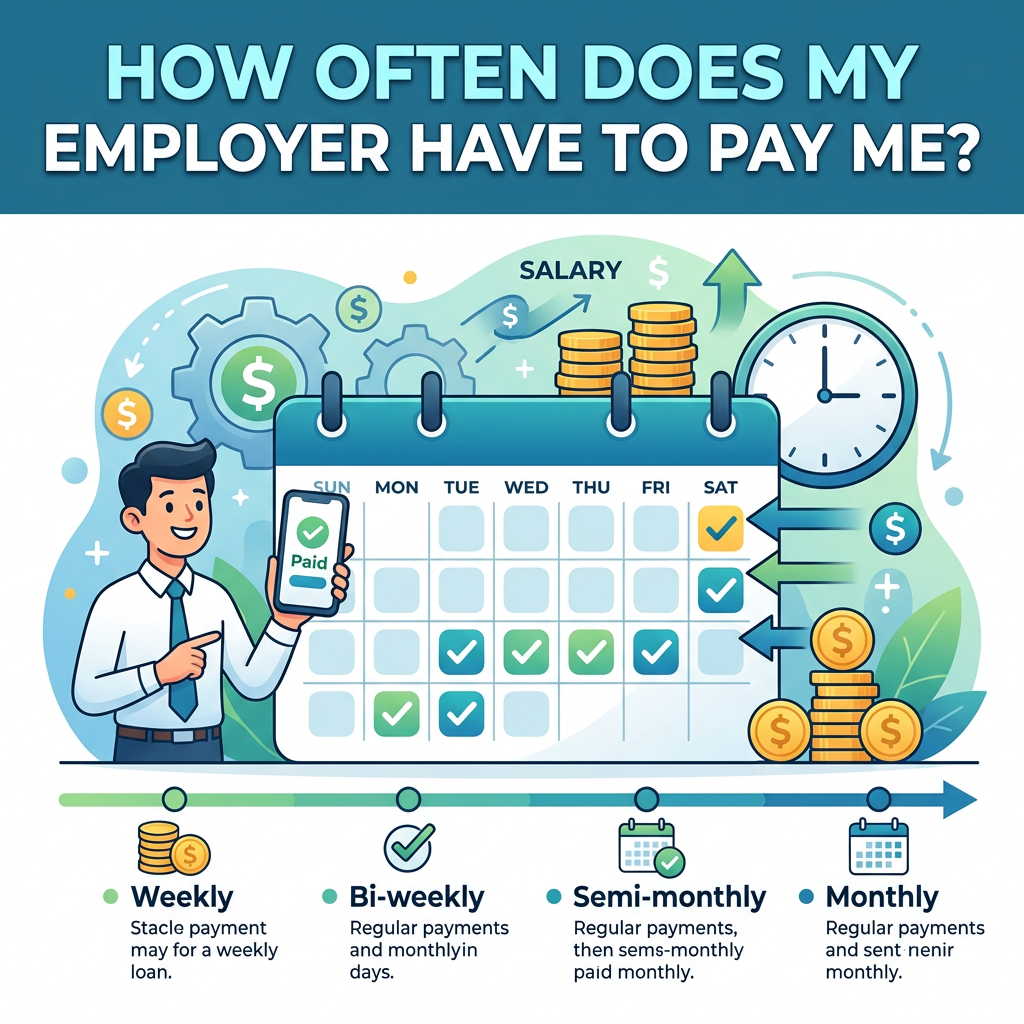

How Often Does My Employer Have to Pay Me?
How often your employer has to pay you depends largely on where you work. Federal law generally requires employers to pay employees for all hours worked, but it does not establish one universal payday schedule for every employee.
Instead, state law usually determines how frequently employees must be paid. Some states require employers to pay employees weekly, while others allow biweekly, semimonthly, or monthly pay schedules.
If your employer regularly pays you late, skips a scheduled payday, or changes your pay schedule without following the law, you may have legal rights.
For more information on payroll and taxes, check out our Payroll & Taxes resource page.
Table of Contents
How Often Does an Employer Have to Pay Employees?
There is no single payday schedule that applies to every worker in the United States.
The federal Fair Labor Standards Act (FLSA) establishes requirements concerning minimum wage, overtime, and other wage protections, but it generally does not require employers to pay employees on a particular weekly or monthly schedule.
State wage laws are often what determine how frequently employees must be paid.
Depending on the state, employers may be required to pay employees:
- Weekly
- Every two weeks (biweekly)
- Twice a month (semimonthly)
- Monthly
- On another schedule permitted by state law
Your employer may also have to follow its established payday schedule once it has been adopted and communicated to employees.
Does Federal Law Require Weekly or Biweekly Pay?
No. Federal law does not generally require employers to issue paychecks every week or every two weeks.
The FLSA requires covered employers to pay employees for the wages they have earned, including required overtime compensation. However, it does not establish a nationwide payday requirement.
That means an employee’s payday rights can vary significantly depending on the state where the employee works.
Can My Employer Change My Payday?
Sometimes.
An employer may be allowed to change its regular pay schedule, but it generally must comply with applicable state wage laws and any other requirements governing the change.
For example, an employer may be permitted to move from a weekly payday to a biweekly payday if the new schedule is lawful and employees are properly informed.
However, an employer generally cannot use a change in the pay schedule as a way to unlawfully withhold wages that employees have already earned.
If a change results in you waiting an unusually long time for wages you have already earned, the timing of the change may matter under state law.
What If My Employer Doesn’t Pay Me on Payday?
If your employer misses a scheduled payday, don’t automatically assume that the delay is legal.
There are several possible explanations for a late paycheck, including:
- A payroll processing error
- A bank or payroll-system problem
- A change in the company’s payroll schedule
- A dispute about the amount owed
- An employer’s failure to process payroll on time
Regardless of the reason, your state may have laws governing when earned wages must be paid.
If your paycheck is late, consider keeping records of:
- Your normal payday
- The date you were actually paid
- Your pay stubs
- The hours you worked
- Any communications from your employer about the delay
- The amount you were supposed to receive
Documentation can become important if the problem happens repeatedly or your employer refuses to pay you.
Can My Employer Hold My First Paycheck?
An employer may sometimes have a legitimate reason why your first paycheck arrives later than you expected.
For example, if you begin working shortly after a payroll period has closed, your first paycheck may not arrive until the next regularly scheduled payday.
That does not necessarily mean your employer is withholding your wages unlawfully.
However, an employer generally cannot simply refuse to pay you for work you performed. The applicable state wage-payment laws determine when those earned wages must be paid.
How Often Do Hourly Employees Have to Be Paid?
Hourly employees are generally subject to the same state payday requirements as other employees, although some states have different rules for different categories of workers.
Being paid hourly does not automatically mean that your employer must pay you every week.
For example, an employer might lawfully pay hourly employees every two weeks in a state that permits a biweekly payroll schedule.
What matters is the applicable law and whether your employer is following it.
How Often Do Salaried Employees Have to Be Paid?
Being paid a salary also does not automatically mean that an employee must receive a paycheck monthly or on another particular schedule.
State law may establish minimum pay-frequency requirements that apply to salaried employees, although exceptions can apply based on the employee’s occupation or other circumstances.
Your employment agreement, company policies, and state law may all be relevant when determining when you should receive your salary.
What If My Employer Pays Me Late Every Time?
A pattern of late paychecks can be more concerning than a one-time payroll mistake.
If your employer consistently pays employees after the legally required payday, the employer may be violating state wage-payment laws.
Repeated late payments can also create evidence that the problem is not simply an isolated payroll error.
If this is happening to you, keep copies of your pay records and consider checking your state’s wage-payment requirements or contacting the appropriate state labor agency.
Can My Employer Withhold My Paycheck?
Generally, an employer cannot simply refuse to pay wages that an employee has already earned.
However, wage withholding and paycheck deductions are governed by a combination of federal and state laws, and some deductions may be lawful.
For example, certain deductions may be permitted when required by law or when otherwise authorized under applicable rules.
If your employer is withholding an entire paycheck, delaying earned wages, or making deductions you do not understand, the circumstances matter.
For more information, see our article on Can Your Employer Deduct Money From Your Paycheck?
What If My Employer Doesn’t Pay Me at All?
A complete failure to pay earned wages is more serious than a routine payroll delay.
If your employer refuses to pay you for work you performed, you may be able to pursue your unpaid wages through a state labor agency, court, or another available legal process.
Depending on the circumstances, you may also have rights under federal wage laws.
You should keep documentation showing:
- When you worked
- How many hours you worked
- Your agreed-upon rate of pay
- Your paychecks and pay stubs
- Any missing wages
- Communications with your employer about the unpaid wages
If your employer owes you wages, don’t assume that you have to simply accept the loss.
What Should I Do If My Paycheck Is Late?
If your paycheck does not arrive when expected, start by determining whether the problem is a temporary payroll error or a potential wage-law violation.
You can:
- Check your pay stub and payroll records.
- Confirm your employer’s normal payday.
- Ask your employer or payroll department when you will be paid.
- Keep written records of the response.
- Check your state’s payday and wage-payment laws.
- Keep documentation if the problem continues.
- Consider filing a wage complaint if your employer does not correct the problem.
If the issue involves a substantial amount of money or continues over multiple pay periods, you may want to speak with an employment attorney about your options.
State Laws Determine How Often You Must Be Paid
Because payday requirements vary from state to state, the answer to “How often does my employer have to pay me?” depends on where you work.
Some states impose specific weekly or biweekly requirements. Others permit employers more flexibility, and certain states have different requirements depending on the type of employee.
That’s why an employee in Pennsylvania, for example, may have different payday rights than an employee in California or New York.
Your state’s wage-payment law is usually the best place to start when determining whether your employer’s payroll schedule is legal.
What If I Think My Employer Is Violating Wage Laws?
If you believe your employer is not paying you on time or is withholding wages you have already earned, you do not necessarily have to resolve the problem on your own.
Start by documenting what happened and reviewing the wage-payment rules that apply to your job.
Depending on the situation, you may be able to file a complaint with your state’s labor department or pursue a private legal claim.
You may also want to consult an employment attorney, particularly if you are owed a significant amount of money or believe your employer is retaliating against you for complaining about unpaid wages.
Related Articles
If you’re dealing with a paycheck problem, you may also want to read:
- Can Your Employer Delay Your Paycheck?
- Can Your Employer Deduct Money From Your Paycheck?
- Can Your Employer Make You Work Through Lunch?
- What Is Wage Theft?
- What Are My Rights If My Employer Doesn’t Pay Me?
You can also explore our Wage Theft & Unpaid Wages resources for more information about getting paid what you are legally owed.
Disclaimer
This article provides general information about employment law and is not legal advice. Employment laws vary by state and situation, and laws can change. If you believe your employer has violated your rights, consider consulting a qualified employment attorney or the appropriate government agency for advice about your specific circumstances.
Please read our Terms and Conditions.
Article; How Often Does My Employer Have to Pay Me?
Discover more from Worker Wisdom℠
Subscribe to get the latest posts sent to your email.