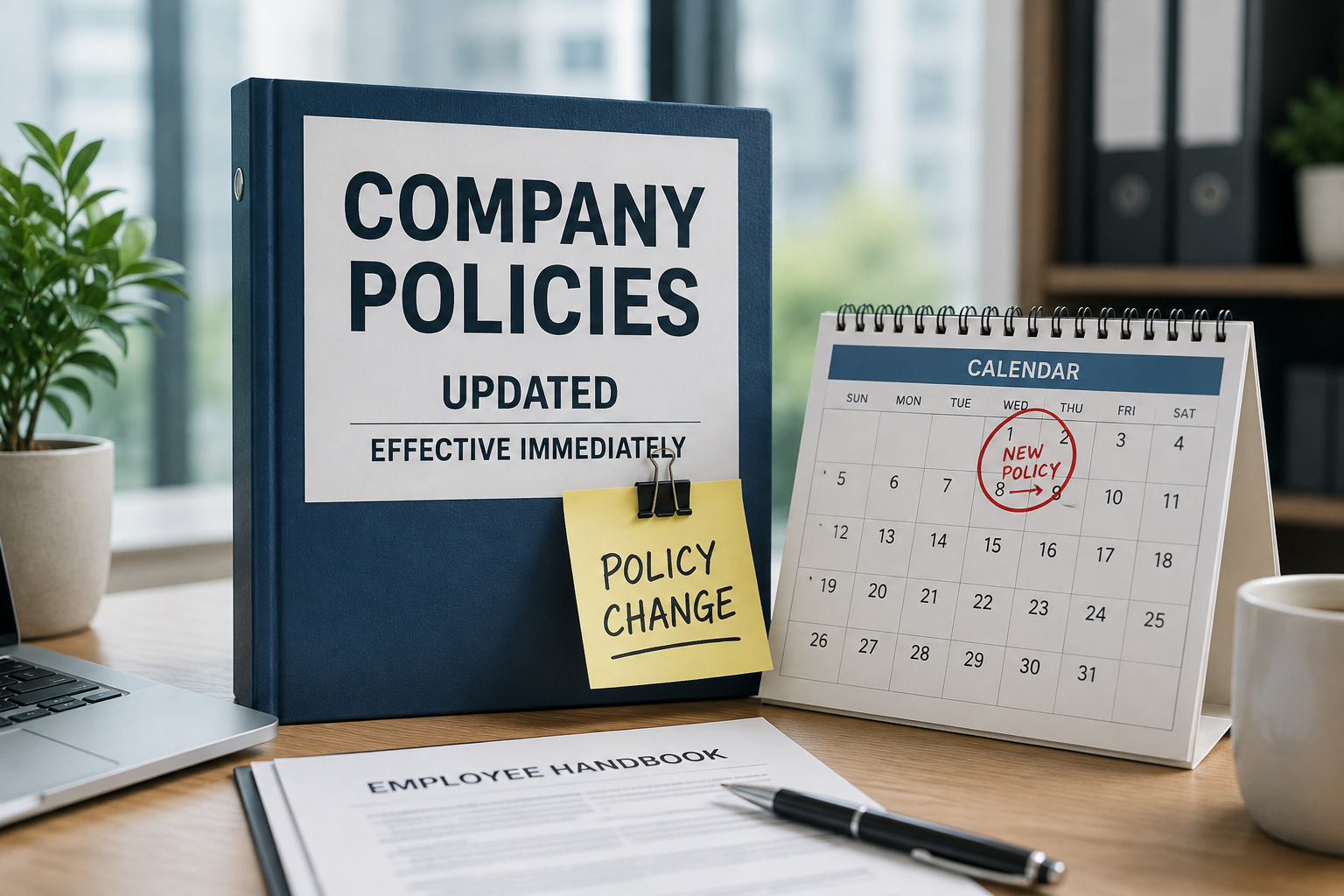

Can an Employer Change Its Policies Without Notice?
If your employer suddenly changes a workplace rule, you may wonder whether the company is allowed to do that without telling employees first.
Maybe your employer changes its attendance policy, introduces a new dress code, changes how employees request time off, or suddenly requires employees to follow a rule that was not in place when they were hired.
In many situations, an employer can change its workplace policies without giving employees advance notice. But that does not mean an employer can change any policy in any way it wants.
The employer may still have to follow employment agreements, collective bargaining agreements, federal and state laws, and other legal requirements. Some policies also involve rights that employers are legally required to protect or provide.
Here’s what employees should know when an employer changes a workplace policy without notice.
Table of Contents
Can an Employer Change a Workplace Policy Without Notice?
Generally, yes.
For many employees, workplace policies are rules established by the employer rather than permanent contractual promises. An employer may have the ability to revise those rules as business needs change.
For example, an employer might change:
- Attendance and call-off procedures
- Dress and appearance requirements
- Remote-work rules
- Scheduling procedures
- Workplace technology rules
- Personal-device policies
- Performance expectations
- Workplace conduct rules
- Timekeeping procedures
- Vacation or PTO procedures
Federal law generally does not require employers to provide advance notice every time they change an ordinary workplace rule.
For example, the Fair Labor Standards Act does not generally regulate employee scheduling. The U.S. Department of Labor says an employer may generally change an employee’s scheduled hours without advance notice unless a prior agreement with the employee or the employee’s representative says otherwise.
However, whether an employer can change a particular policy without notice depends on what the policy involves and what other legal obligations apply.
Why the Employee Handbook Matters
An employee handbook can make a policy change more complicated.
Many handbooks contain language stating that the employer reserves the right to change, revise, suspend, or eliminate policies. If the handbook clearly reserves that authority, the employer may have more flexibility to change its rules.
But an employee handbook is not automatically meaningless just because an employer calls it a “policy manual.”
The wording of the handbook, employment agreement, offer letter, and other documents can matter. State law can also affect whether particular handbook provisions create contractual obligations.
For that reason, an employee who believes a policy change violates an agreement should look at the actual language rather than assuming the employer is automatically allowed to make the change.
Can an Employer Change a Policy Immediately?
Sometimes.
There is generally no universal federal rule requiring an employer to give employees a certain number of days’ notice before changing an ordinary workplace policy.
For example, an employer could announce:
“Effective Monday, employees must submit all schedule-change requests through the new scheduling system.”
That type of procedural change may generally be permissible, even if employees were previously allowed to use a different process.
But an employer cannot avoid other legal requirements simply by calling something a “policy.”
If the new rule affects wages, legally protected leave, discrimination rights, accommodations, or another area regulated by law, additional requirements may apply.
There Are Limits on What an Employer Can Change
The fact that an employer can change workplace policies does not give the employer unlimited authority.
A policy change may create legal problems if it:
Violates an Employment Agreement
If an employee has an employment contract or another enforceable agreement that addresses a particular term of employment, the employer may not necessarily be free to disregard that agreement simply by changing its handbook.
For example, an employer generally cannot use a new workplace policy to automatically eliminate a contractual benefit if the agreement requires the employer to provide it.
The exact result depends on the agreement and applicable state law.
Violates Wage and Hour Laws
An employer cannot use a new policy to avoid wage-and-hour obligations.
For example, an employer cannot simply create a new “no overtime” policy and use that policy as a reason not to pay legally required overtime to an employee who is entitled to it.
Similarly, workplace policies cannot authorize deductions or other practices that violate applicable wage laws.
The U.S. Department of Labor notes that federal and state wage laws may both apply, with employees receiving the higher protection when applicable.
Takes Away Legally Protected Leave Rights
An employer may have significant flexibility when creating its own PTO or attendance procedures, but those policies cannot eliminate legally protected leave.
For example, covered employers have specific notice and documentation obligations under the Family and Medical Leave Act.
The Department of Labor states that covered employers must provide employees with required FMLA notices, including information about eligibility and rights and responsibilities. If information in the rights-and-responsibilities notice changes, the employer must provide written notice of the change within the required timeframe.
That means an employer cannot simply change an internal leave policy and use the change to eliminate rights provided by the FMLA.
For more information about workplace leave protections, see our coverage of FMLA & Medical Leave Rights.
Discriminates Against Employees
A policy change can also be unlawful if it discriminates against employees because of a legally protected characteristic.
Federal law prohibits discrimination in employment based on characteristics including race, color, religion, sex, national origin, age 40 or older, disability, and genetic information. The prohibition applies to employment terms and conditions, including matters such as pay, leave, work assignments, and discipline.
For example, an employer generally cannot create a new policy that is intentionally designed to disadvantage employees because of a protected characteristic.
Some facially neutral policies can also create legal concerns if they have a discriminatory effect and are not legally justified.
Retaliates Against an Employee
An employer also cannot use a policy change as a way to punish an employee for engaging in legally protected activity.
For example, suppose an employee reports suspected workplace discrimination. Shortly afterward, the employer creates a new rule that applies specifically to that employee or uses a newly adopted policy to impose punishment because of the complaint.
The timing alone does not automatically prove retaliation, but a policy change can become legally significant if it is being used as part of retaliatory conduct.
The EEOC states that employees are protected from retaliation for activities such as complaining about discrimination, participating in an investigation, or opposing conduct they reasonably believe violates employment discrimination laws.
What About Employees With Disabilities or Religious Beliefs?
A new workplace policy may also need to account for reasonable accommodations.
For example, an employer might introduce a new attendance, scheduling, dress, or workplace-access policy. If an employee needs an exception because of a disability or religious practice, the employer may have obligations under applicable law.
The EEOC explains that employers may need to modify workplace rules or permit exceptions when an employee requests an accommodation for a disability or religious practice, unless doing so would create an undue hardship under the applicable law.
So an employer generally cannot assume that a newly adopted policy automatically applies identically to every employee regardless of legally protected accommodation rights.
What If the Employer Changes the Policy in a Unionized Workplace?
Unionized employees may have additional protections.
When employees are represented by a union, the employer may have collective bargaining obligations concerning changes to working conditions.
The National Labor Relations Board has stated that employers generally cannot make certain unilateral changes to the working conditions of union-represented employees when the union has not clearly and unmistakably waived its right to bargain over the change.
A collective bargaining agreement may also contain specific rules about how workplace policies can be changed.
If you are covered by a union contract, check the agreement before assuming that an employer can immediately change a policy.
Does an Employer Have to Give Employees a New Handbook?
Not necessarily.
There is an important difference between changing a policy and being legally required to provide notice of a particular legal right or obligation.
An employer may be able to update an ordinary workplace policy without distributing an entirely new employee handbook.
But certain laws require employers to provide specific notices or information to employees.
The FMLA, for example, requires covered employers to provide particular notices concerning employees’ FMLA rights and responsibilities.
Other federal, state, or local laws may impose their own notice requirements.
What If the Employer Says the New Policy Is Effective Immediately?
An employer can sometimes make a policy effective immediately.
Whether that is legally permissible depends on what is being changed.
There is a big difference between:
“Starting today, employees must use the new timekeeping app.”
and:
“Starting today, employees no longer receive wages or benefits that they are legally entitled to receive.”
The first may be a routine workplace-policy change. The second could violate employment law.
The important question is therefore not simply whether the employer gave notice. It is what the employer changed and whether the change is legally permitted.
What Should You Do If Your Employer Changes a Policy Without Notice?
If you are surprised by a new workplace rule, consider taking the following steps.
1. Get the New Policy in Writing
If the change was announced verbally, ask for a copy of the new policy or written instructions.
You may want to keep a copy of the old policy as well.
2. Compare the Old and New Rules
Look at exactly what changed.
Ask:
- What did the old policy say?
- What does the new policy say?
- When does the change take effect?
- Does it affect pay, benefits, leave, scheduling, or discipline?
- Does the employer’s handbook reserve the right to change policies?
3. Check Your Employment Agreement
If you signed an employment agreement, offer letter, union contract, or another document addressing the issue, review it carefully.
A policy change may not override a separate contractual obligation.
4. Consider Whether the Change Affects a Legal Right
Pay particular attention if the new policy affects:
- Wages or overtime
- Protected leave
- Disability accommodations
- Religious accommodations
- Discrimination protections
- Retaliation protections
- Safety rights
- Union rights
- Other rights protected by federal, state, or local law
5. Ask Your Employer for Clarification
If you do not understand the new rule, ask your manager or HR department to explain it.
Consider asking questions in writing so you have a record of the response.
6. Keep Records
Save copies of:
- The old policy
- The new policy
- Emails announcing the change
- Text messages or other written instructions
- Your employment agreement
- Relevant pay records
- Communications with HR
Keeping accurate records can be especially important if the policy change later becomes part of a dispute.
Can You Refuse to Follow a New Workplace Policy?
Usually, you should be cautious about simply refusing to follow a newly announced workplace rule.
Even if you believe the policy is unfair, an employer may generally expect employees to follow legitimate workplace rules.
However, there can be important exceptions when the rule conflicts with the law, an employment agreement, a collective bargaining agreement, or legally protected rights.
Employees also have certain rights to engage in protected concerted activity concerning workplace conditions. The National Labor Relations Board explains that employees can have the right to act together with coworkers regarding issues such as wages, benefits, and working conditions.
That does not mean every disagreement with a new policy is legally protected. The circumstances matter.
If you believe a new policy is unlawful, consider getting legal advice before taking an action that could result in discipline or termination.
Frequently Asked Questions
Can my employer change the employee handbook without telling me?
Generally, an employer may be able to revise its handbook without providing advance notice, particularly when the handbook reserves the right to make changes. However, the employer still must comply with applicable laws, contracts, and other legal obligations.
Can my employer change a workplace policy overnight?
Sometimes. There is generally no universal federal requirement that employers give employees advance notice before changing every ordinary workplace policy. However, specific laws, agreements, or state and local requirements may require notice or restrict the change.
Can my employer change its attendance policy without notice?
Often, yes. But a new attendance policy cannot be used to interfere with legally protected leave, disability accommodations, religious accommodations, or other protected rights.
Can my employer change its PTO policy without notice?
It depends. Employers may have significant flexibility to establish and change their PTO policies, but state law, employment agreements, existing earned benefits, and other legal requirements can affect whether and how a PTO policy may be changed.
Can an employer change a policy after an employee complains to HR?
An employer is not automatically prohibited from changing a workplace policy simply because an employee complained to HR. However, if the change is being used to punish an employee for engaging in legally protected activity, it could raise retaliation concerns.
Does an employer have to give 30 days’ notice before changing a workplace policy?
There is no general federal rule requiring employers to give employees 30 days’ notice before changing ordinary workplace policies. Specific laws or agreements may impose different requirements.
The Bottom Line: Can an Employer Change Its Policies Without Notice?
An employer can often change its workplace policies without giving employees advance notice—but there are important limits.
A routine change to an internal workplace rule may be completely lawful. But an employer cannot use a policy change to override an employment contract, violate wage laws, eliminate legally protected leave, discriminate against employees, retaliate against protected activity, or disregard applicable union bargaining obligations.
If your employer suddenly changes a policy that affects your pay, benefits, leave, accommodations, discipline, or other important employment rights, look beyond the handbook itself. The most important question is whether the new policy conflicts with a law, agreement, or other legal protection that applies to your situation.
For more information about workplace rules and employee protections, visit our Workplace Rules & Policies hub and our broader Employee Rights hub.
Related Articles
- Can Your Employer Make You Work on Your Day Off?
- Can Your Employer Make You Work Through Lunch?
- Can Your Employer Deduct Money From Your Paycheck?
- Can Your Employer Take Away Earned PTO? What Employees Need
Disclaimer
Worker Wisdom provides general information about employment laws and workplace issues for educational purposes only. It is not legal advice and does not create an attorney-client relationship. Employment laws vary by state and circumstances, and laws may change over time. If you have a specific employment dispute or believe your rights have been violated, consider consulting a qualified attorney or an appropriate government agency. Please read our Terms and Conditions.
Article: Can an Employer Change Its Policies Without Notice?
Discover more from Worker Wisdom℠
Subscribe to get the latest posts sent to your email.