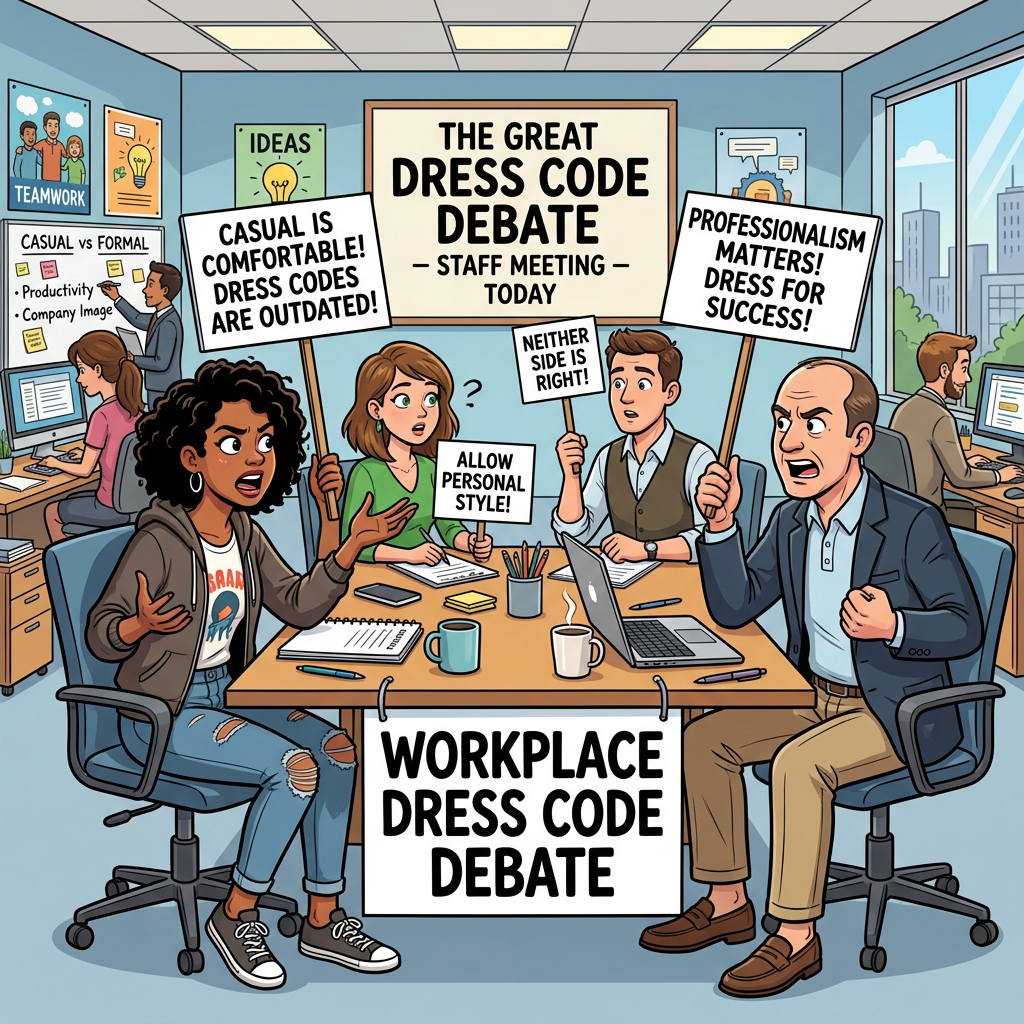

Your employer can generally set rules about what you wear to work, including requiring uniforms, business attire, specific shoes, or certain grooming standards. But those rules have limits.
Dress codes are part of the broader workplace rules employers can establish, but they still have to comply with employment laws. See our Workplace Rules & Policies hub for more information about your rights when employers create or enforce workplace policies.
A dress code may become a legal issue if it discriminates against employees or conflicts with a religious belief, disability, pregnancy-related limitation, or other protected right.
So, can your employer require a dress code? Generally, yes—but there are important exceptions.
Table of Contents
The Short Answer
Generally, yes. An employer can require employees to follow a dress code.
The Equal Employment Opportunity Commission (EEOC) recognizes that employers may establish dress codes for legitimate reasons, including workplace safety, employee identification, customer interaction, and maintaining a particular professional image.
A dress code might require employees to:
- Wear a uniform
- Wear business or business-casual clothing
- Wear specific colors
- Wear closed-toe or nonslip shoes
- Cover tattoos
- Avoid certain jewelry or accessories
- Follow grooming standards
- Wear protective equipment
- Keep hair or facial hair within certain safety requirements
However, the employer’s policy still has to comply with applicable employment laws.
If you’re dealing with a specific type of workplace appearance rule, you may also want to read Can an Employer Tell You What to Wear?, which covers the broader question of employer control over employee clothing and appearance.
Why Can Employers Require a Dress Code?
Employers generally have legitimate business reasons for establishing appearance standards.
Professional Appearance
A company may want employees who interact with customers, clients, patients, or the public to maintain a particular appearance.
For example, an employer might require:
- Business attire
- Business-casual clothing
- Company-branded shirts
- A particular color scheme
- Clean and neat clothing
An employer generally does not have to allow employees to wear whatever they want simply because the employee prefers it.
Workplace Safety
Safety is another common reason for a dress code.
Depending on the job, an employer may require employees to wear:
- Hard hats
- Safety glasses
- Protective footwear
- Gloves
- Protective clothing
- Hair restraints
- High-visibility clothing
Employers may have stronger justification for clothing requirements when the clothing protects employees, coworkers, customers, or the public.
Uniforms and Brand Identity
Some employers require employees to wear uniforms so customers can easily identify them.
Restaurants, hotels, hospitals, retailers, airlines, security companies, and other businesses may have legitimate reasons for requiring employees to wear particular clothing.
The Department of Labor recognizes that employers can require uniforms, although federal wage laws can limit how the cost of required uniforms is passed on to employees.
Can an Employer Make You Pay for a Required Uniform?
Sometimes—but federal wage laws place important limits on deductions and uniform costs.
Under the Fair Labor Standards Act (FLSA), if an employer requires a uniform, the cost generally cannot reduce a covered employee’s wages below the applicable federal minimum wage or cut into required overtime compensation.
For example, an employer generally cannot require a minimum-wage employee to purchase an expensive required uniform if doing so effectively causes the employee’s wages to fall below the federal minimum wage.
State laws may impose additional restrictions.
There is also an important distinction between a true uniform and ordinary clothing.
If an employer simply requires employees to wear ordinary clothing such as khaki pants and a particular style of shirt, the federal rules concerning uniforms may apply differently because those clothes can generally be worn outside of work.
Can a Dress Code Be Discriminatory?
No. An employer cannot use a dress code to discriminate against employees based on a legally protected characteristic.
Federal employment discrimination laws prohibit discrimination based on characteristics including:
- Race
- Color
- Religion
- Sex
- National origin
- Disability
Other federal, state, and local laws may provide additional protections.
A dress code that appears neutral on its face can still create legal problems if it is adopted or enforced for discriminatory reasons.
Can an Employer Have Different Dress Codes for Men and Women?
Possibly, but there are limits.
Federal law does not necessarily require employers to impose identical dress rules on men and women. The EEOC has recognized that certain sex-specific dress and grooming requirements may be lawful when they are suitable, consistently enforced, and impose equivalent burdens.
But a policy can become unlawful if it treats one sex less favorably or imposes substantially different burdens.
For example, an employer could face discrimination concerns if:
- Women are required to wear uniforms while similarly situated men are not
- Women are required to wear sexually revealing clothing
- A dress rule is based on stereotypes about how men or women should look
- The employer enforces appearance rules more harshly against one sex
Title VII also prohibits employment discrimination because of transgender status or sexual orientation. As a result, employers need to be careful about dress-code rules that are applied in a discriminatory manner to transgender employees.
Can an Employer Ban Religious Clothing?
Not necessarily.
Religious dress and grooming receive special protection under Title VII.
If an employee’s sincerely held religious beliefs conflict with a workplace dress or grooming requirement, the employee can request a religious accommodation. Unless providing the accommodation would create an undue hardship, the employer generally must make an exception to its normal policy.
Religious dress can include things such as:
- Hijabs
- Yarmulkes
- Turbans
- Religious jewelry
- Religious clothing
- Certain hairstyles
- Religious facial-hair practices
An employee generally does not have to use specific legal terminology to request an accommodation. The employee should explain that the dress or grooming practice is required by their religious beliefs and that the workplace policy creates a conflict.
What About Customer Complaints?
An employer generally cannot simply deny a religious accommodation because customers or coworkers do not like the employee’s religious clothing.
The EEOC specifically states that customer preference does not provide a defense to religious discrimination.
There can be situations involving genuine safety, security, or other substantial business concerns, but the employer should evaluate the requested accommodation rather than automatically assuming that it creates an undue hardship.
Can an Employer Ban Cultural or Ethnic Clothing?
Employers generally can establish neutral dress requirements, but they cannot enforce those rules in a discriminatory manner.
For example, the EEOC explains that an employer may establish a dress code that applies to employees in similar jobs, but the employer cannot treat certain ethnic or national-origin attire less favorably simply because of its connection to a particular group.
Similarly, hairstyle rules can raise discrimination concerns when they are applied differently because of race or ethnicity.
State and local laws may provide additional protection for hairstyles and cultural expression.
What If a Disability Makes the Dress Code Difficult to Follow?
The Americans with Disabilities Act (ADA) may require an employer to modify a dress code or permit an exception when an employee needs an accommodation because of a disability.
The EEOC specifically recognizes that dress codes can sometimes need to be modified for employees with disabilities, unless doing so would create an undue hardship.
For example, an employee might need:
- Alternative footwear
- Modified clothing
- A different uniform material
- An exception to a grooming requirement
- Adaptive clothing
- Modified protective equipment
The employer does not necessarily have to grant the employee’s preferred accommodation if another effective accommodation is available.
The important question is whether the employee needs a reasonable modification because of a qualifying disability and whether the requested accommodation can be provided without undue hardship.
What If You Are Pregnant?
Pregnancy can also affect workplace dress and uniform requirements.
The Pregnant Workers Fairness Act (PWFA) requires covered employers to provide reasonable accommodations for known limitations related to pregnancy, childbirth, or related medical conditions unless the accommodation would cause an undue hardship.
The EEOC specifically lists changing a uniform or dress code or providing safety equipment that fits as examples of potential accommodations.
For example, an employee whose pregnancy makes a required uniform uncomfortable or impossible to wear may be able to request a reasonable modification.
Pregnancy-related accommodations can vary depending on the employee’s circumstances and the employer’s obligations under federal, state, and local law.
Can an Employer Require Specific Shoes or Grooming?
Yes, in many circumstances.
An employer may require particular shoes or grooming standards when there is a legitimate reason for doing so.
For example:
- A restaurant may require nonslip shoes.
- A hospital may impose hygiene-related requirements.
- A construction employer may require protective footwear.
- A food-production facility may restrict certain hairstyles or require hair coverings.
- A customer-facing business may establish professional grooming standards.
But safety and business requirements do not automatically override employee rights.
If the requirement conflicts with a protected religious practice, disability, or pregnancy-related limitation, an accommodation may be required.
Can Your Employer Require You to Cover Tattoos?
Generally, an employer may be able to restrict or require employees to cover visible tattoos.
There is no general federal law giving employees a right to display tattoos at work.
However, the situation can change if the tattoo or tattoo-related restriction implicates a protected characteristic.
For example, a tattoo may have a connection to a sincerely held religious belief. A policy that targets employees because of race, religion, sex, or another protected characteristic can also create legal problems.
Your employer’s policy should also be applied consistently rather than selectively targeting certain employees.
For more on this issue, see Tattoo Discrimination at Work: Is it Legal?.
Can Your Employer Change the Dress Code?
Often, yes.
In many workplaces, an employer can change workplace policies—including appearance requirements—unless the change violates an employment contract, collective bargaining agreement, applicable law, or another legal protection.
For example, an employer might change its policy from:
“Business casual”
to:
“Business professional.”
That change may be perfectly legal.
However, the employer still cannot use a new dress code as a way to discriminate against employees or avoid legally required accommodations.
Whether an employer must provide advance notice can also depend on the circumstances, workplace policies, contracts, and state or local law.
For broader information about changes to workplace policies, see Employee Handbook: Everything Employees Need to Know and Can an Employer Change Its Policies Without Notice?.
Can You Be Fired for Violating a Dress Code?
Potentially, yes.
If the dress code is lawful, applies to you, and does not conflict with a protected right or accommodation, an employer may generally discipline an employee for violating it.
Depending on the circumstances and applicable law, discipline could include:
- A verbal warning
- A written warning
- Suspension
- Loss of certain workplace privileges
- Termination
But being disciplined for violating a dress code does not necessarily mean the employer acted lawfully.
You may have a legal issue if, for example:
- The policy is discriminatory.
- The policy is selectively enforced.
- You requested a legally required accommodation and were denied.
- You were punished for requesting an accommodation.
- The dress code conflicts with a protected religious practice.
- The rule violates a state or local employment law.
- The employer is using the dress code to retaliate against you for exercising a protected right.
What Should You Do If You Think Your Dress Code Is Illegal?
If you believe your employer’s dress code violates your rights, start by reviewing the actual policy.
Look for:
- The written dress-code policy
- Employee handbook provisions
- Uniform requirements
- Grooming standards
- Safety requirements
- Rules about tattoos, hair, jewelry, or religious clothing
- Rules about who is responsible for uniform costs
Then document what is happening.
Save relevant emails, text messages, written warnings, photographs of the policy, and communications with your manager or HR department.
If you need an accommodation, clearly explain the reason for the request. For religious accommodations, you generally should explain that the conflict is based on a sincerely held religious belief or practice. For disability or pregnancy-related accommodations, explain that you need a change because of the relevant limitation.
You do not necessarily need to cite a particular law or use legal terminology to begin an accommodation discussion.
The Bottom Line
Can your employer require a dress code? Yes, generally.
Employers usually have the right to establish reasonable clothing, uniform, and grooming standards for legitimate business, safety, and operational reasons.
But a dress code is not a blank check.
Employers cannot use dress and grooming rules to discriminate against employees based on protected characteristics. They may also have to make reasonable exceptions for religious practices, disabilities, and pregnancy-related limitations.
And if an employer requires a uniform, federal wage laws can limit how the employer passes the cost on to employees.
The key question is not simply whether your employer has a dress code. It’s whether the particular rule is lawful, how it is enforced, and whether you have a legally protected reason for needing an exception.
Related Articles
- Can an Employer Tell You What to Wear?
- Tattoo Discrimination at Work: Is it Legal?
- Employee Handbook: Everything Employees Need to Know
- Can an Employer Change Its Policies Without Notice?
Disclaimer
This article is intended for informational purposes only. It provides general information and is not intended and should not be construed as professional advice. We do not represent that the information provided is accurate or up-to-date as laws and regulations are always changing. If you have an issue that requires professional help, you should contact the appropriate professional to help you with your specific set of facts. Please read our Terms and Conditions.
Discover more from Worker Wisdom℠
Subscribe to get the latest posts sent to your email.