
What Is the Fair Labor Standards Act (FLSA)?
The Fair Labor Standards Act (FLSA) is a federal employment law that establishes basic rules for wages, overtime, recordkeeping, and child labor. It applies to many employees in the private sector as well as employees of federal, state, and local governments.
The law is especially important when it comes to minimum wage and overtime pay. However, not every employee is covered in exactly the same way, and some workers are exempt from particular FLSA protections.
Here is what employees should know about the FLSA and how it can affect their rights at work.
Table of Contents
What Does the FLSA Stand For?
FLSA stands for the Fair Labor Standards Act.
Congress enacted the law in 1938 to establish federal standards governing wages and working conditions. The law has been amended many times since then and is administered and enforced primarily by the U.S. Department of Labor’s Wage and Hour Division.
Today, the FLSA establishes federal requirements concerning:
- Minimum wage
- Overtime pay
- Recordkeeping
- Child labor
- Certain employee classifications and exemptions
- Protections against retaliation for exercising certain FLSA rights
The FLSA does not regulate every workplace issue. For example, the federal law generally does not require employers to provide vacation, sick leave, holiday pay, severance pay, or meal and rest breaks.
State and local laws may provide additional protections.
What Does the FLSA Require?
For covered, nonexempt employees, the FLSA establishes several important protections.
Federal Minimum Wage
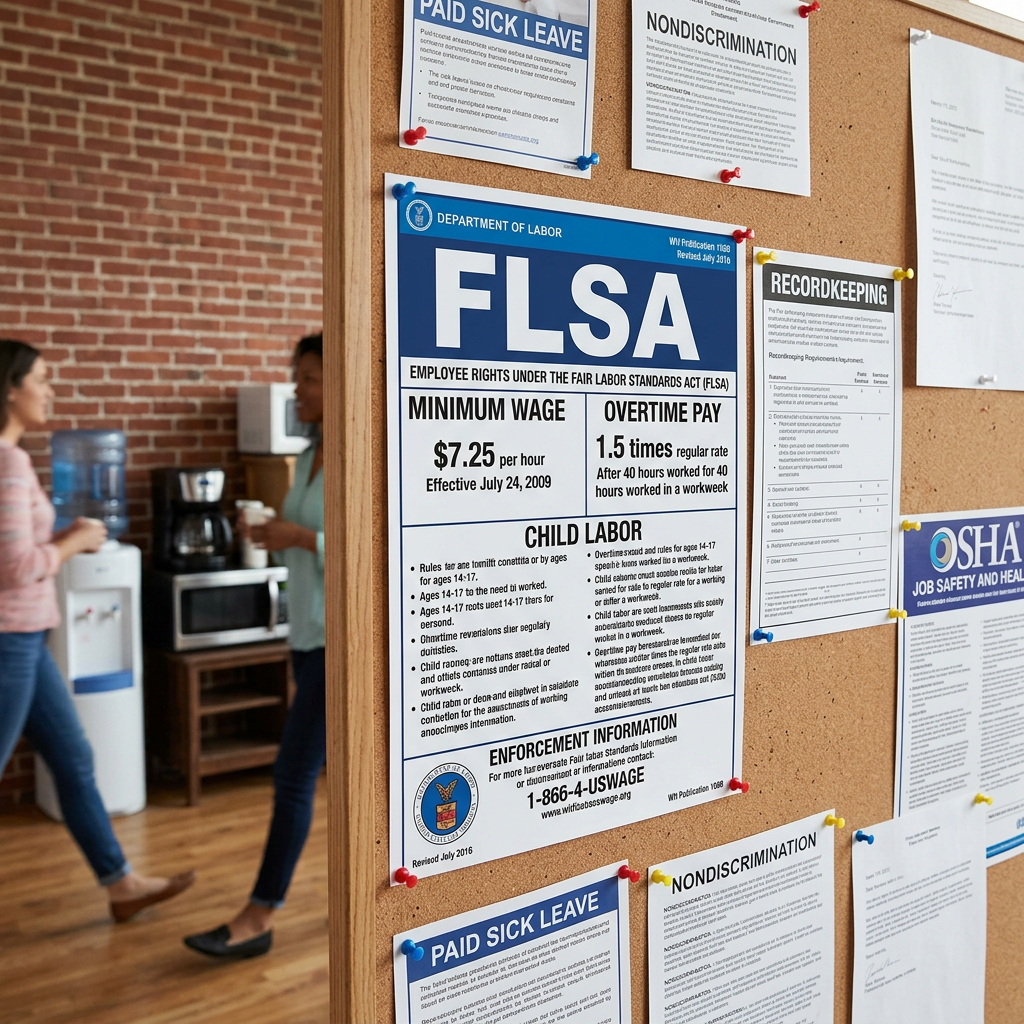
The federal minimum wage is currently $7.25 per hour for covered employees. That rate has been in effect since July 24, 2009.
However, federal law is not necessarily the minimum wage an employee must receive.
Many states and some local governments have their own minimum-wage laws. When an employee is covered by both federal and state or local minimum-wage requirements, the employee generally is entitled to the higher applicable rate.
This means an employee should not automatically assume that $7.25 is the minimum amount their employer can legally pay.
Overtime Pay
One of the best-known FLSA protections is the right to overtime pay.
Covered, nonexempt employees generally must receive overtime at a rate of at least one and one-half times their regular rate of pay for hours worked over 40 in a workweek.
For example, if an employee’s regular rate is $20 per hour, the employee’s FLSA overtime rate would generally be at least $30 per hour.
Importantly, the FLSA measures overtime based on the workweek, not simply the number of hours worked during a particular day.
The FLSA does not generally require overtime merely because an employee works on:
- Saturday
- Sunday
- A holiday
- A regular day off
If those hours cause a covered, nonexempt employee to work more than 40 hours in the workweek, however, overtime may be required.
Recordkeeping
The FLSA also requires covered employers to maintain certain records concerning employees’ time and pay.
Depending on the circumstances, records can include information such as:
- Hours worked
- Wages paid
- Pay rates
- Overtime
- Deductions
- Other employment information required by federal regulations
Employers also generally must display an official FLSA poster explaining employees’ rights and obligations under the law.
Who Is Covered by the FLSA?
The FLSA covers many employees working in the United States, but coverage can depend on the employee, the employer, the type of work performed, and the particular FLSA provision involved.
The law covers employees in the private sector and in federal, state, and local government employment, although special rules can apply to certain government workers.
An important distinction is that being an employee does not automatically mean every FLSA protection applies to you in the same way.
For example, an employee may be covered by the FLSA but qualify for an overtime exemption.
What Is an Exempt Employee Under the FLSA?
The FLSA contains numerous exemptions from its minimum-wage and overtime requirements.
One of the most commonly discussed groups is the so-called white-collar exemptions. These can apply to certain executive, administrative, professional, outside-sales, and computer employees who satisfy specific requirements.
An important point is that an employee’s job title does not determine whether the employee is exempt.
For example, simply calling someone a “manager” does not automatically make that person exempt from overtime. The employee’s actual job duties and, where applicable, salary basis and salary level must satisfy the requirements of the applicable exemption.
Some exemptions apply to both minimum wage and overtime, while others apply only to overtime.
Because FLSA exemptions can be complicated and are narrowly defined, employees should not assume that they are exempt simply because they are salaried or have a particular job title.
Does Being Paid a Salary Mean You Are Exempt From Overtime?
No.
Being paid a salary does not automatically make an employee exempt from overtime.
For certain white-collar exemptions, an employee generally must satisfy both compensation-related requirements and specific duties requirements. The Department of Labor explains that job titles alone do not determine exempt status.
This is one reason employees who are told they are “salaried” or “exempt” should look at the actual requirements of the applicable exemption rather than relying solely on what their employer calls their position.
What Is a Nonexempt Employee?
A nonexempt employee is generally an employee who is entitled to the FLSA’s applicable minimum-wage and overtime protections.
For a covered nonexempt employee, working more than 40 hours in a workweek generally triggers the FLSA overtime requirement.
For example, if a covered nonexempt employee works:
- 40 hours Monday through Friday, there generally is no FLSA overtime based solely on those hours.
- 45 hours during the workweek, the employee generally must receive overtime for 5 hours.
- 50 hours during the workweek, the employee generally must receive overtime for 10 hours.
There are exceptions and special rules for certain occupations and industries, so the general rule does not apply identically to every worker.
Does the FLSA Require Meal or Rest Breaks?
Generally, no.
The FLSA does not generally require employers to provide meal periods, rest breaks, holidays off, or vacations.
That does not mean an employer can always deny an employee a break.
State and local laws may impose separate break requirements, and the FLSA has rules governing when certain short breaks or meal periods that an employer chooses to provide must be counted as paid working time.
The answer can therefore depend on both federal and state law.
Does the FLSA Limit How Many Hours You Can Work?
Generally, the FLSA does not place a maximum number of hours an employee age 16 or older can be required to work in a workweek.
Instead, the law generally requires covered, nonexempt employees to receive overtime pay when they work more than 40 hours in a workweek.
So an employer may generally require a nonexempt employee to work 50 or even 60 hours, provided the employer complies with applicable wage and overtime laws.
Other federal, state, or local laws may impose additional restrictions in particular situations.
What About Child Labor?
The FLSA contains federal child-labor protections designed to protect minors from work that could interfere with their education or expose them to dangerous conditions.
The rules vary depending on the worker’s age, the type of work involved, and other circumstances.
There are separate rules governing agricultural and nonagricultural employment, and additional restrictions apply to certain hazardous occupations.
State child-labor laws may also provide additional protections.
Does the FLSA Apply to Independent Contractors?
Not in the same way.
The FLSA protects employees, while genuine independent contractors are not covered by the law’s minimum-wage and overtime protections.
However, simply calling a worker an “independent contractor” does not necessarily make that person one under the FLSA.
The Department of Labor uses an economic-realities analysis to determine whether a worker is an employee or an independent contractor under the FLSA.
This distinction can be extremely important because a worker who has been incorrectly classified as an independent contractor may potentially be denied minimum-wage or overtime protections that would otherwise apply.
What Does the FLSA Not Cover?
The FLSA is an important federal wage-and-hour law, but it does not regulate every employment issue.
For example, the FLSA generally does not require:
- Paid vacation
- Paid holidays
- Paid sick leave
- Severance pay
- A specific number of meal or rest breaks
- Premium pay simply because someone works on a weekend or holiday
- Pay raises
- Fringe benefits
- A specific amount of advance notice before termination
Some of these issues may be addressed by state law, another federal law, an employment contract, a collective bargaining agreement, or an employer’s own policies.
What Happens If an Employer Violates the FLSA?
If an employer fails to comply with the FLSA, an employee may have legal rights or remedies depending on the nature of the violation.
Potential issues can include:
- Unpaid overtime
- Minimum-wage violations
- Improper deductions
- Failure to pay for compensable working time
- Recordkeeping violations
- Certain child-labor violations
- Retaliation for exercising rights protected by the FLSA
The U.S. Department of Labor’s Wage and Hour Division is responsible for administering and enforcing the FLSA in many employment situations. Employees may also have the right to pursue certain claims privately.
Because deadlines and available remedies can vary, employees who believe they have not been paid properly should consider getting legal advice promptly.
Can an Employer Retaliate Against You for Exercising FLSA Rights?
The FLSA contains protections against retaliation.
An employer generally cannot retaliate against an employee for exercising certain rights protected by the law, such as raising covered wage-and-hour concerns or participating in certain proceedings involving the FLSA.
Retaliation can take different forms. Depending on the circumstances, it could include termination, demotion, reduction in hours, or another adverse employment action.
Whether a particular action constitutes unlawful retaliation depends on the facts and applicable law.
What Should You Do If You Think Your Employer Violated the FLSA?
If you believe your employer may have violated the FLSA, start by documenting what happened.
Consider keeping copies of:
- Pay stubs
- Time records
- Work schedules
- Employment agreements
- Relevant workplace policies
- Emails or text messages concerning your hours or pay
- Records showing when you actually worked
Do not assume that your employer’s classification of you as “exempt,” “salaried,” or an “independent contractor” automatically settles the question.
The details of your job duties, compensation, hours, and working relationship can matter.
You can also review information from the U.S. Department of Labor’s Wage and Hour Division to learn more about federal wage-and-hour protections.
Frequently Asked Questions About the FLSA
What is the FLSA in simple terms?
The Fair Labor Standards Act is a federal law that establishes basic rules for minimum wage, overtime pay, recordkeeping, and child labor.
Is the FLSA a federal law?
Yes. The FLSA is a federal employment law that establishes nationwide minimum standards for covered employees.
Does everyone get overtime under the FLSA?
No. The FLSA provides overtime protection to covered nonexempt employees, but certain employees and occupations are exempt from overtime under specific provisions of the law.
Is overtime after 8 hours or 40 hours?
Under the FLSA, overtime generally is required after 40 hours worked in a workweek, not simply after eight hours in a day. Some state laws have different rules.
Does the FLSA require employers to give lunch breaks?
Generally, no. The FLSA does not generally require meal or rest breaks, although state and local laws may.
What is the federal minimum wage?
The federal FLSA minimum wage is currently $7.25 per hour for covered employees. State or local law may require a higher minimum wage.
Can a salaried employee receive overtime?
Yes. Salary alone does not automatically make an employee exempt from overtime. Whether an employee is exempt can depend on the applicable exemption’s requirements, including the employee’s actual duties and compensation.
Does the FLSA protect independent contractors?
The FLSA’s minimum-wage and overtime protections apply to employees, not genuine independent contractors. Whether someone is actually an employee or an independent contractor depends on the applicable legal test and the facts of the working relationship.
The Bottom Line: What Is the Fair Labor Standards Act (FLSA)?
The Fair Labor Standards Act is one of the most important federal laws governing employee pay.
For covered, nonexempt employees, it establishes a federal minimum wage and generally requires overtime pay at one and one-half times the regular rate for hours worked over 40 in a workweek. It also establishes requirements concerning recordkeeping and child labor and provides protections against certain forms of retaliation.
But the FLSA is not a one-size-fits-all law. Exemptions, industry-specific rules, employee classifications, and state and local laws can all affect an employee’s rights.
If you are trying to determine whether you should have received overtime, whether your employer is paying you legally, or whether you have been properly classified as exempt or an independent contractor, the specific facts of your situation matter.
For more information about your workplace rights, visit our Labor Laws Resource Center and our broader Employee Rights resources.
Disclaimer
This article provides general information about U.S. employment law and is not legal advice. Employment laws can change, and whether a particular law applies depends on the facts and circumstances of each situation. For advice about your specific circumstances, consider consulting a qualified attorney. Please read our Terms and Conditions.
Article: What Is the Fair Labor Standards Act (FLSA)?
Discover more from Worker Wisdom℠
Subscribe to get the latest posts sent to your email.
Pingback: Unlimited PTO: Don’t Be Fooled by the Fine Print