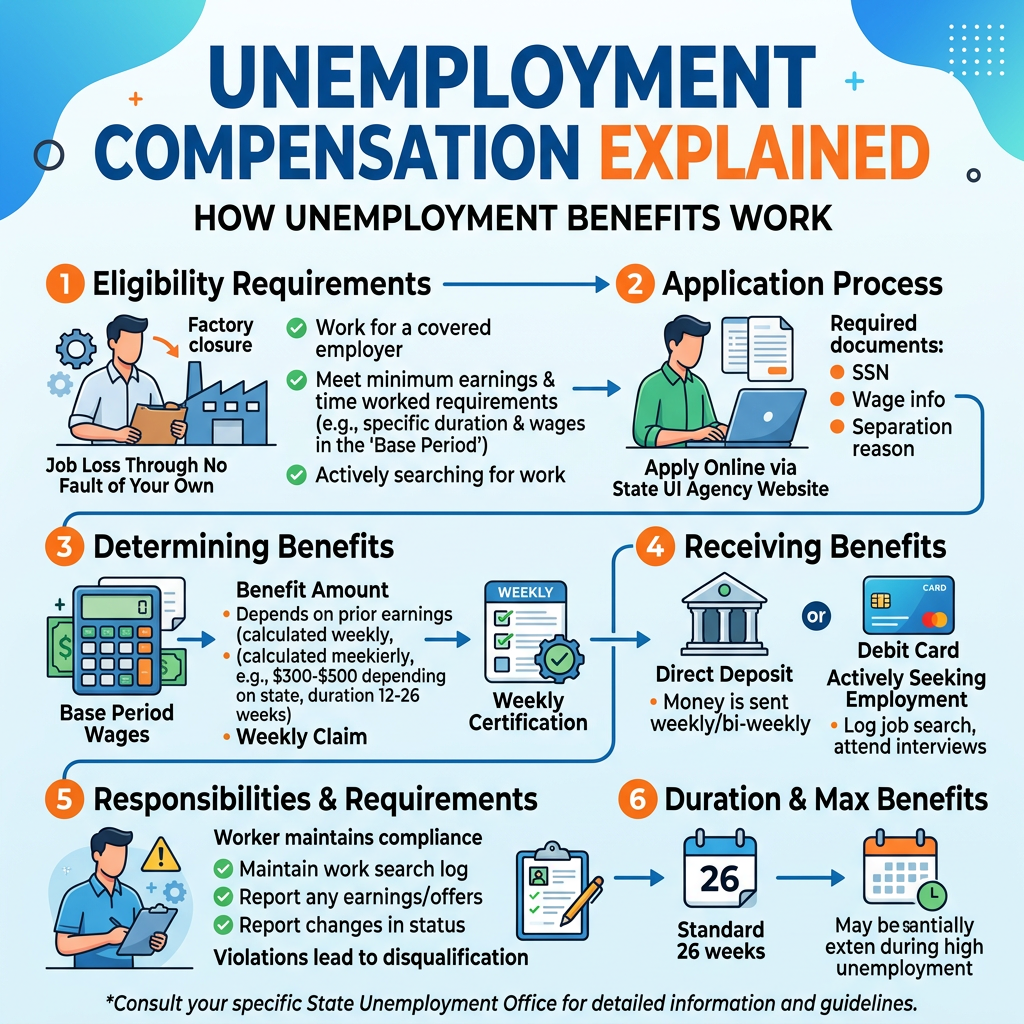

Unemployment Compensation Explained: How Unemployment Benefits Work
Updated 9/9/2026
Losing your job can leave you wondering how you will pay your bills while you look for another job. Unemployment compensation, also called unemployment insurance or unemployment benefits, is designed to provide temporary financial assistance to eligible workers who are unemployed.
But not everyone who loses a job automatically qualifies for unemployment benefits.
Each state operates its own unemployment insurance program and sets its own eligibility requirements, benefit amounts, and rules. In general, you may qualify if you are unemployed through no fault of your own and have earned enough wages or worked enough during a specific period before filing your claim.
Here is what you need to know about unemployment compensation, including who qualifies, how much you may receive, how to apply, and what happens if your claim is denied.
Table of Contents
What Is Unemployment Compensation?
Unemployment compensation is temporary financial assistance for workers who meet their state’s requirements for unemployment insurance benefits.
The program is intended to help eligible workers financially while they are unemployed and looking for new employment.
There is not one nationwide unemployment program that every worker applies for through the federal government. Instead, states administer their own unemployment insurance programs, subject to federal requirements.
The name of the program can also vary. You may hear it called:
- Unemployment compensation
- Unemployment insurance
- Unemployment benefits
- UI benefits
- Unemployment payments
Although the terminology varies, these generally refer to payments made through a state unemployment insurance program.
Who Qualifies for Unemployment Benefits?
Eligibility depends on the state where you file your claim.
Generally, you may qualify if:
- You are unemployed through no fault of your own.
- You earned enough wages during the state’s required base period.
- You worked enough during the required period.
- You are able and available to work.
- You meet your state’s requirements for looking for work.
- You continue to meet the state’s weekly or periodic eligibility requirements.
The exact requirements vary by state.
For example, many states look at your wages and employment history during a specific period before you filed your claim. The U.S. Department of Labor explains that in many states, the base period is generally the first four of the last five completed calendar quarters before the claim is filed.
Whether your claim is straightforward or contested depends largely on which kind of separation you had. Being fired doesn’t automatically disqualify you — the standard is misconduct, which is narrower than most people assume.
What Does “Through No Fault of Your Own” Mean?
One of the most important unemployment eligibility requirements is often whether you became unemployed through no fault of your own.
This commonly includes situations such as:
- Your employer eliminated your position.
- Your employer laid you off.
- Your workplace closed.
- Your employer reduced its workforce.
- Your hours were significantly reduced, depending on state rules.
However, unemployment eligibility can become more complicated if you quit your job or were fired.
Can You Get Unemployment If You Are Fired?
Being fired does not automatically mean you are disqualified from unemployment benefits.
The reason you were fired matters.
If you were fired for reasons that do not amount to disqualifying misconduct under your state’s law, you may still qualify.
However, serious misconduct may result in a denial or disqualification.
Because states define misconduct differently, you should not assume that being fired automatically makes you ineligible—or automatically makes you eligible.
If your employer contests your unemployment claim, the unemployment agency may investigate the circumstances surrounding your termination.
Can You Get Unemployment If You Quit?
Quitting your job can make unemployment eligibility more difficult, but it does not necessarily mean you can never receive benefits.
Some states allow benefits when a worker quits for a legally recognized good cause or another qualifying reason.
Whether your reason for quitting qualifies depends on state law.
Examples of circumstances that may be relevant can include certain serious workplace conditions, health or safety concerns, or other circumstances recognized by state law.
If you quit your job, explain the circumstances honestly when you file your claim.
Can You Get Unemployment If Your Hours Are Reduced?
You may be eligible for unemployment benefits even if you are still working, depending on your state’s rules.
Some states provide partial unemployment benefits to workers whose hours or earnings have been reduced.
For example, you might be working fewer hours because your employer reduced your schedule.
The amount you can earn while receiving unemployment benefits and still qualify varies by state.
You generally must report wages you earn while claiming benefits.
How Much Does Unemployment Pay?
There is no single unemployment benefit amount for everyone.
Each state establishes its own benefit formula.
Your weekly benefit may depend on factors such as:
- Your previous earnings.
- Your wages during the state’s base period.
- Your state’s maximum weekly benefit.
- Your state’s minimum benefit.
- Other state-specific rules.
Higher earnings do not necessarily mean you will receive unlimited unemployment benefits. States generally impose maximum weekly benefit amounts.
You can check your state’s unemployment agency for the current benefit formula and maximum benefit amount.
How Long Can You Receive Unemployment Benefits?
The length of time you can receive unemployment benefits depends primarily on the state and your individual circumstances.
There is no universal number of weeks that applies to every unemployed worker nationwide.
Some states calculate the maximum duration based on your earnings or work history, while others use different formulas.
Your state unemployment agency can tell you how many weeks you may be eligible to receive benefits.
How Do You Apply for Unemployment?
You generally apply through the unemployment insurance agency in the state where you worked.
USAGov explains that, in most cases, you should file in the state where you worked rather than simply assuming you should file in the state where you currently live. If you worked remotely or worked in another state, you may need to contact the appropriate unemployment agency for guidance.
You may be able to file:
- Online
- By telephone
- Through another method provided by your state
When filing, you will generally need information about your employment and earnings.
What Information Do You Need to File an Unemployment Claim?
The exact information required varies by state, but you may need information such as:
- Your name and contact information.
- Your Social Security number.
- Your recent employers.
- Employer addresses and telephone numbers.
- Your employment dates.
- Your wages or earnings.
- The reason you became unemployed.
- Information about your most recent employer.
Having this information available can make the application process easier.
Should You Apply for Unemployment Immediately?
Generally, you should not wait unnecessarily to file a claim after becoming unemployed.
Because state rules and deadlines differ, waiting can potentially affect when you receive benefits or how your claim is handled.
If you lose your job, check your state’s unemployment agency promptly and follow its filing instructions.
Do You Have to Look for a Job While Receiving Unemployment?
Many states require unemployment recipients to be able and available to work and to meet job-search or work-search requirements.
You may have to:
- Look for suitable employment.
- Keep records of your job-search activities.
- Apply for jobs.
- Register with a state employment service.
- Report your job-search activities.
The exact requirements depend on your state.
Do not assume that filing your initial claim is the only step you need to take.
What Is a Weekly Unemployment Certification?
Many states require you to regularly certify that you remain eligible for benefits.
During this process, you may be asked whether you:
- Worked during the week.
- Earned wages.
- Were available to work.
- Refused any work.
- Looked for work.
- Had any other changes that could affect your eligibility.
Answer these questions accurately.
Failing to report work or earnings can result in overpayments, repayment obligations, penalties, or other consequences.
Can You Receive Unemployment If You Have a Part-Time Job?
Possibly.
Some states allow workers to receive partial unemployment benefits when they work part time but earn below a certain amount.
However, your unemployment payment may be reduced based on your earnings.
You generally must report your wages when required by your state.
Never assume that working part time automatically disqualifies you from unemployment—or that you can earn wages without reporting them.
Can You Get Unemployment If You Are Self-Employed?
Self-employed workers and independent contractors generally do not qualify for regular state unemployment benefits simply because they are no longer receiving work.
However, classification can matter.
If you were treated as an independent contractor but believe you were actually an employee, the situation may be different.
Your state’s unemployment agency may examine the nature of your work and your employment relationship.
Can You Get Unemployment If You Were an Independent Contractor?
Being called an “independent contractor” by a company does not necessarily settle the legal question of your employment status.
If you believe you were incorrectly classified as an independent contractor, you may want to explain the circumstances to the appropriate government agency.
Employment classification can affect whether you are entitled to unemployment benefits and other employment protections.
What Happens After You File an Unemployment Claim?
After you submit your claim, the unemployment agency reviews your application.
The agency may verify information such as:
- Your employment history.
- Your wages.
- The reason you became unemployed.
- Information provided by your former employer.
- Whether you meet the state’s eligibility requirements.
Your former employer may also be asked to provide information about your separation from employment.
The agency then determines whether you qualify under the applicable state rules.
Can Your Employer Fight Your Unemployment Claim?
Yes.
An employer may provide information to the unemployment agency if it disputes your eligibility.
For example, an employer may disagree about:
- Why you were terminated.
- Whether you quit voluntarily.
- Whether you committed misconduct.
- Whether you were available to work.
- Whether you were actually employed during a particular period.
The unemployment agency—not simply your former employer—makes the eligibility determination under applicable law.
What If Your Unemployment Claim Is Denied?
If your claim is denied, do not automatically assume that the decision is final.
States generally provide an appeal process for unemployment determinations.
Your determination notice should explain:
- Why your claim was denied.
- Whether you have a right to appeal.
- How to appeal.
- The deadline for filing an appeal.
Pay close attention to the deadline.
If you believe the decision is incorrect, follow the appeal instructions provided by your state’s unemployment agency.
What Happens During an Unemployment Appeal?
The appeal process varies by state.
You may be asked to participate in a hearing or provide additional information.
Depending on the circumstances, you may need to explain:
- Why you lost your job.
- What your employer told you.
- Whether you quit or were fired.
- What happened immediately before your separation.
- Whether you were able and available to work.
- Any other facts relevant to your eligibility.
Keep copies of relevant documents and communications.
Can You Get Unemployment If You Are Looking for a Job?
Yes. In fact, actively seeking work is generally an important part of receiving unemployment benefits.
Unemployment insurance is generally intended to provide temporary assistance while eligible workers seek new employment.
Many states require recipients to meet specific work-search requirements.
Is Unemployment Compensation Taxable?
Unemployment compensation can have federal income-tax consequences.
If you receive unemployment benefits, you may receive tax reporting information from the unemployment agency.
Tax treatment can change, so you should review the current federal and state tax rules applicable to your benefits and circumstances.
Is Unemployment Compensation the Same as Severance Pay?
No.
Unemployment benefits are government-administered benefits for eligible unemployed workers.
Severance pay is compensation provided by an employer after employment ends, usually under an employer policy, employment agreement, or other arrangement.
Receiving severance can affect unemployment benefits in some states or circumstances, so you should report severance when required and check your state’s rules.
Is Unemployment Compensation the Same as Workers’ Compensation?
No.
These are different programs.
Unemployment compensation generally provides temporary financial assistance to eligible workers who are unemployed.
Workers’ compensation generally provides benefits to eligible workers who suffer work-related injuries or illnesses.
The requirements and benefits are different.
What If You Were Laid Off?
A layoff is one of the most common situations in which a worker may qualify for unemployment benefits.
If your employer eliminated your position because there was not enough work, you may meet the “no fault of your own” requirement used by many unemployment programs.
However, you still need to satisfy your state’s other eligibility requirements.
What If Your Employer Closes?
If your employer closes its business and you lose your job as a result, you may be eligible for unemployment benefits.
A business closure generally means the separation was caused by a lack of available work rather than something you did as an employee.
You must still meet the other requirements imposed by your state.
What If You Are Temporarily Laid Off?
A temporary layoff may qualify for unemployment benefits depending on your state’s rules and the circumstances.
If your employer tells you that you will return to work after a temporary period, ask your state’s unemployment agency whether you should file a claim and what requirements apply.
What If You Refuse a Job While Receiving Unemployment?
Unemployment recipients generally must remain able and available for suitable work.
Refusing suitable work can affect your eligibility depending on the circumstances and your state’s law.
If you receive a job offer while collecting benefits, do not simply assume that accepting or rejecting it has no effect on your claim.
Follow your state’s reporting requirements and determine whether the work is considered suitable under applicable law.
What Is an Unemployment Overpayment?
An unemployment overpayment occurs when an unemployment agency determines that you received more benefits than you were entitled to receive.
This can happen for several reasons, including:
- An agency later determines that you were not eligible.
- You failed to report wages.
- Your eligibility changed.
- The agency made an administrative error.
- Benefits were paid before a later eligibility determination.
If you receive an overpayment notice, read it carefully and follow the instructions for repayment or appeal.
What If Someone Files Unemployment Benefits in Your Name?
Unemployment fraud can involve someone using another person’s identity to file a fraudulent unemployment claim.
If you receive an unexpected unemployment notice, payment, or tax form for benefits you did not receive, take it seriously.
USAGov recommends reporting suspected unemployment fraud to the appropriate state unemployment program and taking steps to protect your identity.
Can You Get Unemployment During a Government Shutdown or Other Emergency?
Special unemployment programs can sometimes become available under federal or state law during particular emergencies or disasters.
For example, Disaster Unemployment Assistance may provide benefits to certain people who become unemployed as a direct result of a presidentially declared major disaster and who meet the program’s requirements.
These programs are different from regular state unemployment benefits and are not automatically available whenever someone loses a job.
What Should You Do If You Lose Your Job?
If you become unemployed, consider taking these steps:
- Find your state’s unemployment agency.
- File your claim promptly.
- Keep copies of everything you submit.
- Continue meeting weekly or periodic certification requirements.
- Report all required wages and other information accurately.
- Complete any required job-search activities.
- Read every determination notice carefully.
- Appeal promptly if you believe your claim was incorrectly denied.
- Keep records of communications with your former employer and the unemployment agency.
The Bottom Line: Unemployment Compensation
Unemployment compensation provides temporary financial assistance to eligible workers who are unemployed and meet their state’s requirements.
The most important thing to understand is that unemployment rules are not identical across the United States. States establish their own eligibility requirements, benefit calculations, application procedures, and other rules, while the federal government provides the framework and oversight for the unemployment insurance system.
If you lose your job, do not assume that you are automatically disqualified because you were fired, quit, worked part time, or received another type of compensation. Your eligibility depends on the specific circumstances and the law of the state handling your claim.
Check your state’s unemployment agency as soon as possible after losing your job and follow its filing and reporting requirements.
Related Resources
- Can Your Employer Fire You Without Warning?
- Can You Be Fired for Refusing to Work Overtime?
- Can Your Employer Make You Work on Your Day Off?
- Why Is My Paycheck So Small?
Disclaimer
This article provides general information about unemployment compensation and is not legal advice. Unemployment laws and eligibility requirements vary by state and can change over time. If you have a specific unemployment dispute or your claim has been denied, consider consulting an attorney or contacting your state’s unemployment agency for guidance.
Please read our Terms and Conditions.
Article: Unemployment Compensation Explained: How Unemployment Benefits Work
Discover more from Worker Wisdom℠
Subscribe to get the latest posts sent to your email.
Pingback: Are Employers Required To Offer Benefits To Part-Time Employees? - Worker Wisdom™