
Updated September 2026
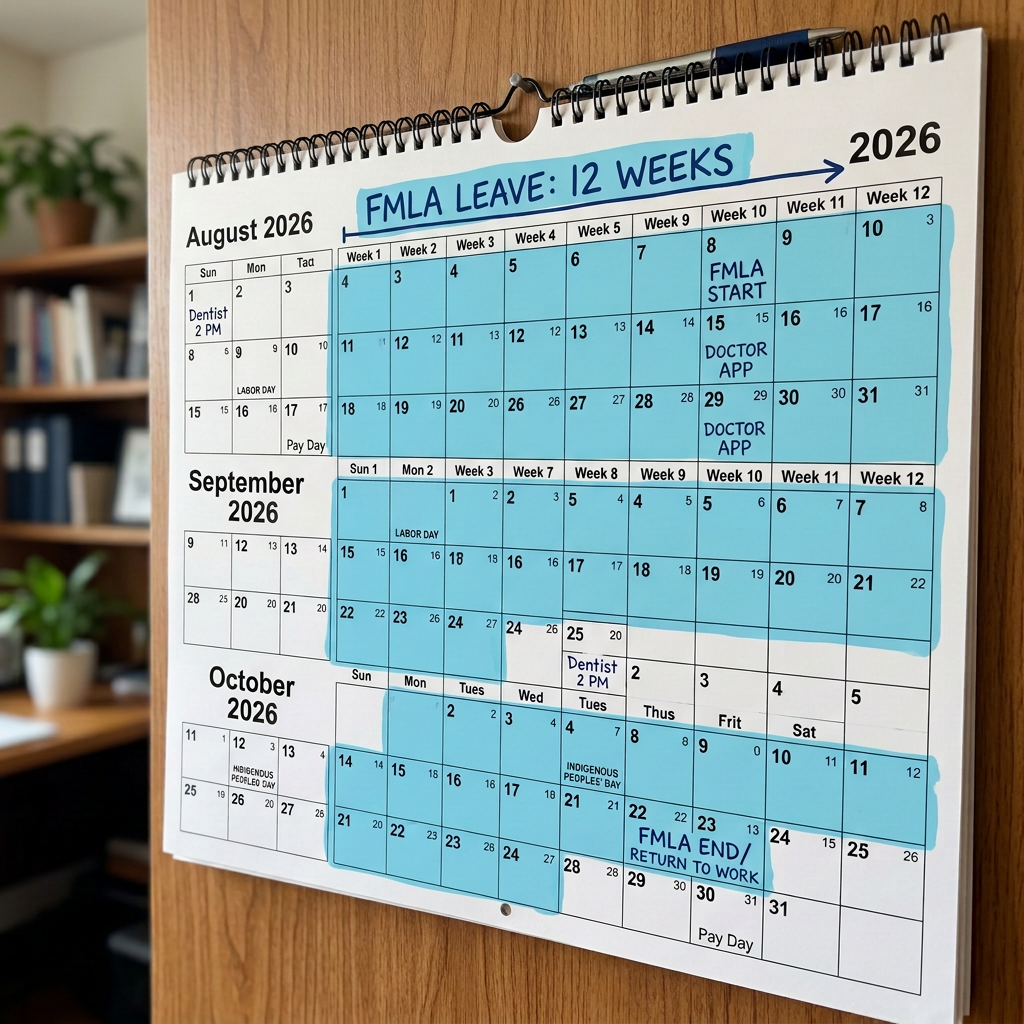
FMLA gives eligible employees 12 workweeks of unpaid, job-protected leave in a 12-month period — 26 weeks if you’re caring for a service member. That’s the answer, and you probably already knew it.
Most people look this up for one of two reasons. Either you’re planning leave and trying to work out what you’ll have, or you’re already on it, the end is coming, and you’re not ready to go back. The number answers neither.
What decides your situation is how your employer counts that 12-month period — which can leave two people with identical leave histories holding different amounts on the same day — and what protections you still have once the weeks are gone.
Table of Contents
How Long Does FMLA Last? The 12-Week Rule
Before the 12 weeks matter, you have to be eligible — and whether part-time hours get you there is the question that stops most people. Double check this first.
Twelve workweeks, not twelve calendar weeks, within a 12-month period defined by your employer. It’s unpaid, though your employer can require you to use PTO concurrently.
To be eligible you need all four of these:
- You’ve worked for your employer for at least 12 months (they don’t have to be consecutive)
- You’ve worked at least 1,250 hours in the 12 months before the leave — about 24 hours a week
- Your employer has 50 or more employees within 75 miles of your worksite
- Your reason qualifies — your own serious health condition, caring for a spouse/child/parent with one, or birth, adoption or foster placement within the first year
If any one of those fails, FMLA doesn’t apply to you at all, whatever your employer’s policy says. See what qualifies as a serious health condition.
The 26-Week Exception for Military Caregivers
Military caregiver leave runs up to 26 workweeks in a single 12-month period to care for a covered service member or certain veterans with a serious injury or illness incurred in the line of duty. That 26 weeks is a combined total for all FMLA reasons in that year, not 26 on top of 12.
Qualifying exigency leave — for deployment-related needs like childcare arrangements, legal affairs or attending military events — falls under the normal 12 weeks.
How Your Employer Counts the 12 Months
This is the section that changes people’s answers, and almost nobody checks it.
Your employer picks one of four methods under 29 CFR 825.200 and must apply it consistently to everyone:
| Method | How it works |
|---|---|
| Calendar year | Your 12 weeks reset every January 1 |
| Fixed leave year | A set 12-month block — fiscal year, or your hire anniversary — resetting on that date |
| Rolling forward | The 12 months start the day your first FMLA leave begins, and reset 12 months later |
| Rolling backward | Each time you request leave, your employer looks back 12 months and counts what you’ve already used |
The rolling-backward method is the one that surprises people, and it’s common because it prevents leave-stacking across a year boundary.
Here’s how it works in practice. Say you took 6 weeks of FMLA last March. In February you request leave again. Under a calendar-year method you’d have a fresh 12 weeks. Under rolling-backward, your employer looks back over the previous 12 months, sees the 6 weeks from March, and tells you that you have 6 weeks available — not 12. Those 6 weeks then return to you gradually, week by week, on the anniversary of each week you used.
Two things worth knowing:
Your employer has to tell you which method they use, usually in the handbook or your FMLA designation notice. If they never designated one, the method most favorable to you applies. That is worth raising if you’re being told you’re out of leave.
They can change methods, but they must give you 60 days’ notice, and the transition can’t cost you leave you’d have had under the old method.
What a “Workweek” Means if You Work Part-Time
FMLA gives you 12 of your workweeks, not 12 of somebody else’s.
If you work five days a week, that’s 60 workdays. If you work three days a week, it’s 36. If you work 20 hours a week, your entitlement is 240 hours, against 480 for someone full-time. The protection is proportional, so part-time employees aren’t shortchanged — but they also don’t get a full-timer’s hours.
If your schedule varies, your employer typically uses a weekly average over the previous 12 months.
How Intermittent Leave Is Deducted
Taking FMLA in blocks — a few hours for treatment, a day for a flare-up — draws down the same 12 weeks, but in smaller pieces.
Your employer must deduct it in the smallest increment they use for other kinds of leave, and never more than one hour. If you take two hours for an appointment, they can deduct two hours. They cannot deduct a half-day or a full day for it. If your pay stub or leave balance suggests otherwise, that’s worth questioning in writing.
What Doesn’t Count Against Your 12 Weeks
Holidays, in most cases. If you’re on FMLA for a full week that contains a holiday, the whole week counts. But if you’re taking less than a full week, the holiday generally doesn’t count against you.
Time your employer failed to designate. If they knew the leave qualified and didn’t tell you it was FMLA, that time may not count. This comes up more often than you’d think.
Leave you didn’t actually take. If you were approved for 12 weeks and returned after 8, you have 4 weeks left in that period.
What Happens When Your FMLA Runs Out
The job-protection guarantee ends. Your employer is no longer required by the FMLA to hold your position or reinstate you. That’s the hard part, and it’s why people search this question at all.
But FMLA ending doesn’t mean every protection ends:
The ADA may keep going. If your condition is a disability, additional unpaid leave can itself be a reasonable accommodation, and your employer has to consider it rather than terminating automatically. This is the single most important thing to know at week 11, and most people don’t. See how to request a reasonable accommodation and can you extend FMLA beyond 12 weeks.
State law may go further. Several states provide longer or paid leave than the federal minimum. See paid family leave vs FMLA.
Your employer’s own policy may allow more. Many handbooks provide extended medical leave beyond the statutory minimum. Ask, in writing.
Short-term disability may still pay, even with no job protection attached. See short-term disability vs FMLA.
Health insurance: your employer’s obligation to maintain your coverage ends with the leave, and if you don’t return they may recover the premiums they paid — with exceptions for circumstances beyond your control. See what happens to your health insurance during FMLA.
And retaliation protection doesn’t expire. Being fired after leave ends is lawful in some situations, but not if the leave itself was the reason. See what happens if you don’t return to work after FMLA and can you be fired while on FMLA.
How to Find Out How Much You Have Left
Four steps, and the first two answer it for most people.
- Check your FMLA designation notice. Your employer must give you one within five business days of learning your leave qualifies. It states the method used and your entitlement.
- Check the handbook for the 12-month method if the notice doesn’t say.
- Ask HR in writing: “Which 12-month method does the company use for FMLA, and how many weeks do I have available as of today?” A written answer is worth having.
- Do the arithmetic yourself using the method they name, and compare. If the numbers differ, ask them to reconcile it before you rely on theirs.
Frequently Asked Questions
Is FMLA 12 Weeks Per Year or Per Condition?
Per 12-month period, not per condition. Multiple qualifying events draw from the same 12 weeks.
Does FMLA Reset Every January?
Only if your employer uses the calendar-year method. Under a rolling-backward method it never resets at a fixed point — it recovers gradually as old leave ages out.
Can I Take FMLA More Than Once in a Year?
Yes, as often as you need, for any qualifying reason, until the 12 weeks are used up.
Do My Spouse and I Each Get 12 Weeks?
Usually yes — unless you work for the same employer. If you do, you may be limited to a combined 12 weeks for bonding with a new child or caring for a parent. Your own serious health condition isn’t subject to that limit.
Is FMLA Paid?
No. It’s unpaid job protection. Your employer can require you to use accrued PTO at the same time, and state programs or short-term disability may provide income.
Can My Employer Make Me Take All 12 Weeks at Once?
No. You take what you need, and intermittent or reduced-schedule leave is available where it’s medically necessary.
What If I’ve Been There Less Than a Year?
You’re not eligible for FMLA. Check whether your state’s leave law has a shorter service requirement, and whether your condition would support an ADA accommodation instead.
The Bottom Line
Twelve weeks is the easy part. The two questions that decide your situation are which 12-month method your employer uses, and what you’ll do at week 11.
If you’re likely to need more time, the move is to raise the ADA question before the leave runs out, not after. Once you’ve been terminated, you’re arguing about a decision that’s already been made. Asking at week 10 whether additional leave could be a reasonable accommodation puts the obligation on your employer while you still have your job.
And if you’ve been told you’re out of leave, check the method. If your employer never designated one in writing, the count most favorable to you applies — and that has given people weeks back.
Disclaimer
This article is for general information only and is not legal advice. FMLA rules are detailed and turn on individual facts, state law may provide more, and reading this article does not create an attorney-client relationship. Consult a licensed attorney in your state about your specific situation. Please read our Terms and Conditions.
Related Articles
- Can You Extend FMLA Beyond 12 Weeks?
- What Happens If You Don’t Return to Work After FMLA?
- Can Your Employer Deny FMLA Leave?
- What Qualifies as a Serious Health Condition Under FMLA?
- Can You Use PTO and FMLA at the Same Time?
- Short-Term Disability vs. FMLA
Discover more from Worker Wisdom℠
Subscribe to get the latest posts sent to your email.
Pingback: What Qualifies as a Serious Health Condition Under FMLA? - Worker Wisdom℠