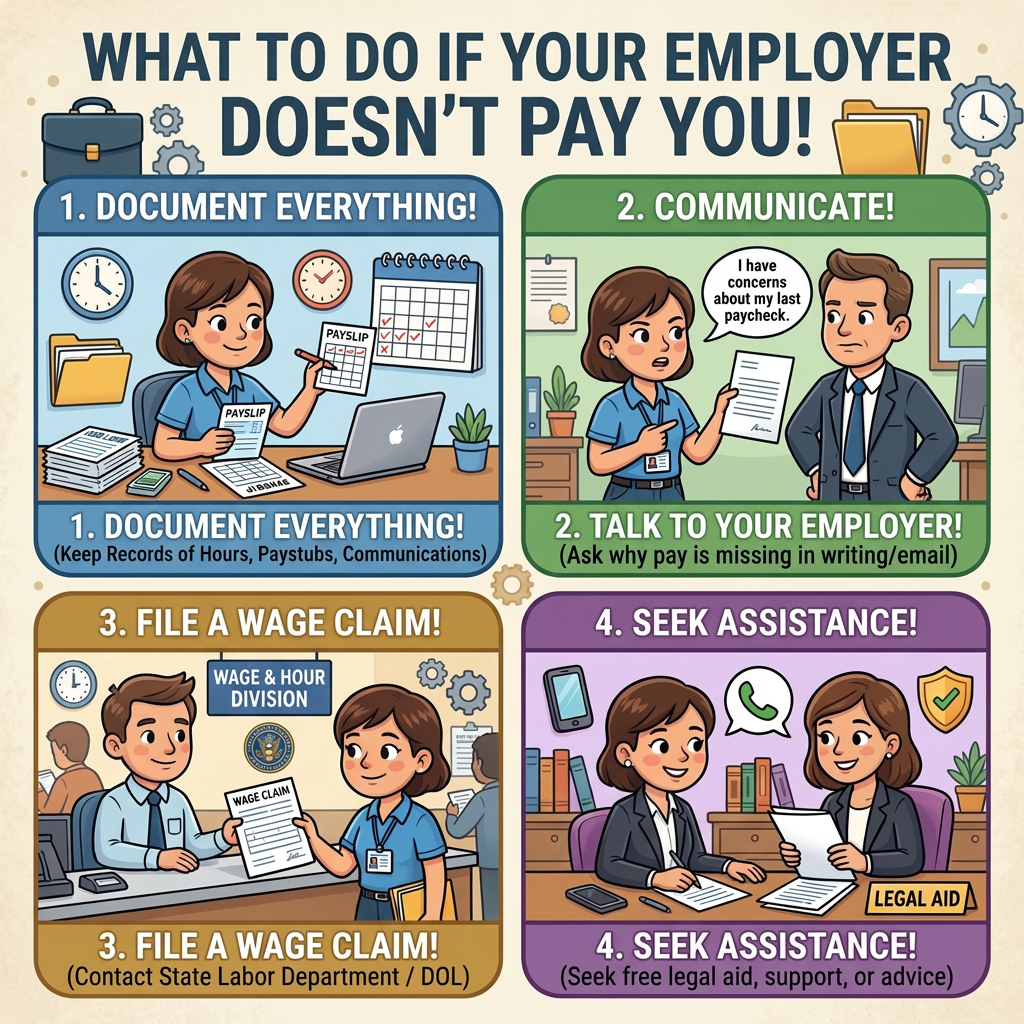

What to Do If Your Employer Doesn’t Pay You
If your employer doesn’t pay you, don’t assume you simply have to wait for your money.
Depending on what you were supposed to be paid, why you weren’t paid, and where you work, your employer may have violated federal or state wage laws. You may be owed regular wages, overtime, commissions, or other compensation.
The good news is that there are practical steps you can take.
If your employer hasn’t paid you, start here:
- Check whether your normal payday has actually passed.
- Figure out exactly how much money you are owed.
- Gather your pay stubs, time records, schedules, and other evidence.
- Ask your employer or payroll department to correct the problem, preferably in writing.
- If a simple written request doesn’t work, send a formal wage demand letter with a deadline.
- If the employer still doesn’t fix the problem, determine whether to contact your state labor agency, the U.S. Department of Labor, or an employment attorney.
- Keep track of deadlines that may apply to your claim.
The important thing is not to ignore the problem or assume that your employer’s explanation is necessarily correct. Here’s what you need to know.
Table of Contents
Is It Illegal for an Employer Not to Pay You?
It can be.
Under the federal Fair Labor Standards Act (FLSA), covered nonexempt employees generally must receive at least the required minimum wage for all hours worked and overtime pay at one and one-half times their regular rate for hours worked over 40 in a workweek. Wages required under the FLSA generally must be paid on the regular payday for the pay period in which they were earned.
However, not every unpaid-wage dispute is governed by the FLSA. Federal law does not generally establish a nationwide payday schedule, require immediate payment of a final paycheck when employment ends, or provide a federal collection procedure for every type of promised compensation or commission. State laws may provide additional protections.
That means the answer can depend on what you were supposed to be paid and which state’s law applies to you.
What Should You Do First If Your Employer Doesn’t Pay You?
Before filing a complaint or confronting your employer, figure out exactly what happened.
1. Check Your Normal Payday
First, make sure the payment is actually late. Look at your employer’s normal payroll schedule and determine:
- What dates the pay period covers
- When that pay period normally ends
- Your regular payday
- Whether weekends or holidays affect the payment date
- Whether you recently changed banks or payment methods
- Whether you were recently hired and missed the payroll cutoff
Federal law generally requires covered FLSA wages to be paid on the regular payday for the applicable pay period, but payday requirements can also come from state law, and those rules vary significantly from state to state.
2. Figure Out Exactly What You Are Missing
Don’t simply tell your employer, “You didn’t pay me.” Determine exactly what you believe you are owed — your entire paycheck, several hours of regular wages, overtime pay, a commission, a promised payment, wages from your final paycheck, an improper deduction, or minimum wages required by law.
Write down the dates you worked, the hours you worked, your rate of pay, and the amount you believe you should have received.
If your paycheck was issued but the amount is wrong, see What Should I Do If My Paycheck Is Wrong?
3. Gather Your Records
Start collecting evidence before you escalate. Useful records include pay stubs, time sheets, time-clock records, work schedules, emails, texts, employment agreements, offer letters, commission agreements, payroll communications, bank statements, and your own written record of hours worked if your employer’s records are incomplete.
The Department of Labor can investigate federal minimum-wage and overtime complaints, and detailed records of your hours and pay can be critical to establishing what you were owed.
4. Ask Your Employer to Correct the Problem
If you believe you were not paid correctly, contact your employer. You can start with payroll, human resources, your supervisor, or whoever normally handles payroll questions.
Keep the request simple and factual. Explain the pay period involved, the hours or wages missing, the amount you believe you’re owed, why you believe it’s incorrect, and when you’d like it corrected.
Whenever possible, make the request in writing. A written request creates a record showing you raised the issue and gives the employer a chance to investigate a possible payroll mistake. You don’t have to threaten a lawsuit or government complaint in your first message — a straightforward request is often the best place to start.
5. Send a Formal Written Wage Demand
If your informal request doesn’t resolve the issue within a reasonable time, escalate to a formal written demand.
Your demand letter should include:
- Your job title
- The specific dates worked
- The amount you believe you’re owed (as precisely as you can calculate it)
- A clear request for immediate payment
- A deadline for response — typically 7 to 14 days
Send it in writing (email is fine, and creates a timestamp) and keep a copy. This step matters even if you never end up filing a formal complaint: a documented demand with a deadline creates a clear paper trail that strengthens your position if you need to escalate to a labor agency or attorney later, and it shows you gave your employer a fair opportunity to correct the problem before involving anyone else.
What If Your Employer Says It Was a Payroll Mistake?
Payroll mistakes do happen — hours entered incorrectly, an unapproved time sheet, being left off payroll, a failed direct deposit, overtime calculated wrong, or a deduction entered in error.
If your employer acknowledges the mistake, ask when the missing wages will be paid, ideally in writing. But an employer’s statement that something was a “payroll mistake” doesn’t automatically mean the delay is legally permissible — covered minimum wages and overtime generally must still be paid on the regular payday, and state law may impose additional requirements.
What If Your Employer Says It Doesn’t Have the Money?
An employer’s financial problems do not automatically eliminate its obligation to pay wages required by federal law. The Department of Labor states that, in general, covered nonexempt employees must receive their required minimum wage and statutory overtime on the regularly scheduled payday even when an employer is experiencing financial difficulties.
If your employer says it cannot make payroll, document what you were told and keep your records. It’s also worth checking whether your state has additional wage-payment protections.
What If You Were Not Paid Overtime?
If you worked more than 40 hours in a workweek, you may be entitled to overtime under the FLSA unless an exemption applies. Covered, nonexempt employees generally must receive at least one and one-half times their regular rate for hours worked over 40 in a workweek.
The calculation can get more complicated when commissions or bonuses are involved, and being paid a salary does not automatically mean you’re exempt — that depends on the applicable exemption and your actual job duties. For a deeper look at eligibility and misclassification, see Can You Legally Refuse Unpaid Overtime?
If you believe you were denied overtime, document all hours actually worked, including time before or after your scheduled shift, unpaid prep time, remote or weekend work, and time spent answering work messages off the clock.
What If You Were Told Not to Work Overtime?
Being told not to work overtime and actually working overtime creates a complicated situation. If your employer knew or had reason to believe you were working, simply saying you weren’t authorized doesn’t necessarily eliminate its obligation to pay you for that time. The important issue is the work actually performed, not just the instruction given. Keep records of both.
What If Your Employer Says You Are an Independent Contractor?
Being called an “independent contractor” doesn’t necessarily settle whether you’re legally an employee. Under the FLSA, factors used to determine the distinction include control over your work, opportunity for profit or loss, your own investment in the work, how permanent the relationship is, whether your work is integral to the business, and your skill and initiative.
If you believe you were misclassified and denied minimum wage or overtime as a result, that misclassification may be part of your wage claim.
What If You Were Fired or Quit?
Don’t assume your final paycheck must be issued immediately under federal law — the FLSA doesn’t generally require that. State law may set a specific deadline for final wages, and those requirements differ by state. Depending on your state and situation, your final pay may also need to include commissions or accrued vacation. Check your specific state’s rules rather than assuming a general nationwide standard applies.
What If Your Employer Owes You a Commission or Bonus?
Not every commission or bonus dispute is automatically an FLSA violation. The FLSA generally doesn’t provide a federal collection procedure for promised wages or commissions beyond its minimum-wage and overtime requirements — state law, your employment agreement, or a specific commission agreement usually governs. Save the agreement or policy describing how it’s earned, along with records showing you met the requirements for payment.
What If Your Employer Made an Improper Deduction?
Some paycheck deductions are lawful; others violate federal or state wage law. Under the FLSA, certain deductions cannot reduce a covered employee’s wages below minimum wage or cut into overtime compensation that’s legally owed. If you believe a deduction was improper, save the pay stub showing it and determine exactly what it was for.
What If Your Employer Doesn’t Fix the Problem?
If you’ve asked your employer to correct the issue — informally and through a formal demand — and it remains unresolved, it’s time to escalate. Depending on the situation, you may:
- Contact your state’s labor agency
- File a complaint with the U.S. Department of Labor’s Wage and Hour Division
- Consult an employment attorney
- Pursue a private wage claim
The Wage and Hour Division accepts complaints involving federal minimum-wage and overtime violations, and there’s no charge to file or to have your complaint investigated.
When Should You Contact the Department of Labor?
The DOL may be the right option when your situation involves federal wage-and-hour requirements, like unpaid minimum wages or overtime. You don’t need to know exactly which law was violated before contacting the agency — the Wage and Hour Division can help you determine whether a federal issue is involved.
When Should You Contact Your State Labor Agency?
Your state labor agency may matter most when your issue involves state-specific rules — pay frequency, final-wage deadlines, state minimum wage, deductions, or certain commissions. Because these rules vary widely, consult your specific state’s labor agency for the official requirements that apply to you. Filing is free and no lawyer is needed, but an order and a payment aren’t the same thing. How to file a wage claim with your state labor agency covers the form, the timeline, and what to do before you file so there’s something left to collect from.
Can Your Employer Fire You for Complaining About Unpaid Wages?
Federal law provides retaliation protections for certain wage complaints. The DOL states that workers may be protected from retaliation for activities like inquiring about pay or hours, asserting worker rights, filing complaints, or cooperating with a Wage and Hour Division investigation.
If your employer threatens, disciplines, demotes, cuts your hours, or fires you after you complain about a wage violation, document what happened. Retaliation law can be nuanced, though — not every compensation disagreement automatically rises to a federal retaliation claim.
What You Should NOT Do If Your Employer Doesn’t Pay You
- Don’t rely only on verbal conversations. Put important requests and responses in writing.
- Don’t throw away your records. Keep pay stubs, schedules, time records, and communications.
- Don’t assume your employer is correct about your legal rights. Payroll or a manager can misunderstand the law.
- Don’t assume being salaried means you can’t be owed overtime. Exempt status depends on actual job duties, not just pay structure.
- Don’t alter your own time records to match what your employer claims you worked.
- Don’t take confidential company information you’re not entitled to have — preserve evidence lawfully.
- Don’t wait indefinitely. Wage claims have deadlines.
How Long Do You Have to Claim Unpaid Wages?
Don’t assume you have unlimited time. Under the FLSA, the general federal limitations period for a wage claim is two years, extending to three years for a willful violation. State laws can set different deadlines, and other claim types may have their own limitations periods. Because the applicable deadline depends on the type of claim, investigate your rights promptly.
A Simple Plan If Your Employer Doesn’t Pay You
- Check your payday — confirm the payment is actually late.
- Calculate what you’re owed — dates, hours, rate, overtime, commissions.
- Gather your evidence — pay stubs, time records, schedules, communications.
- Contact your employer in writing — explain what’s missing and ask for a correction.
- Send a formal wage demand with a deadline if the informal request doesn’t work.
- Escalate if the employer refuses to pay — state labor agency, U.S. Department of Labor, or an employment attorney.
- Pay attention to deadlines — don’t let the problem sit until a claim becomes harder to pursue.
The Bottom Line
If your employer doesn’t pay you, don’t simply assume you have to accept the loss. First determine exactly what you were supposed to receive and whether the payment is actually late. Then document the problem and make a clear written request — followed by a formal demand if needed.
If your employer still refuses to correct the problem, look at both federal and state wage laws. Federal law provides important protections concerning minimum wage, overtime, and certain retaliation, while state law can provide additional protections concerning payday requirements, final pay, and other wage disputes.
The most important thing is to act, keep good records, and avoid assuming that one general rule applies to every unpaid-wage situation.
Our Wage Theft & Unpaid Wages resources cover related issues, including incorrect paychecks, overtime, and other pay problems.
Related Articles
- What Should I Do If My Paycheck Is Wrong?
- How Often Does My Employer Have to Pay Me?
- Not Getting Paid on Time? What to Do When Your Paycheck Is Late
- Can You Legally Refuse Unpaid Overtime?
Disclaimer
This article provides general information about employment laws and is not legal advice. Employment laws vary by state and situation, and laws can change over time. If you believe your employer has violated your wage rights or you are considering taking legal action, consider consulting a qualified employment attorney or the appropriate government agency about your specific circumstances.
Please read our Terms and Conditions.
Last updated: September 2026
Discover more from Worker Wisdom℠
Subscribe to get the latest posts sent to your email.