
Why Employers Require a Job Application When You Already Submitted a Resume
If you have ever applied for a job online, you may have wondered why you were asked to fill out a lengthy job application after already submitting a resume.
After all, your resume already contains your work history, education, skills, and other information the employer needs to decide whether you are qualified. So why make you enter much of the same information again?
The short answer is that a resume and a job application serve different purposes. Your resume is a document you create to present your qualifications. A job application is a standardized document the employer uses to collect information from applicants in a consistent format.
Although filling out the same information twice can feel redundant, there are several reasons employers require both. Here’s what you need to know.
If you’re navigating the job application process, our Job Search & Applications guide offers more information to help you apply for jobs and navigate the hiring process.
Table of Contents
Why Do Employers Require a Job Application and a Resume?
Employers may require a job application in addition to a resume for several reasons.
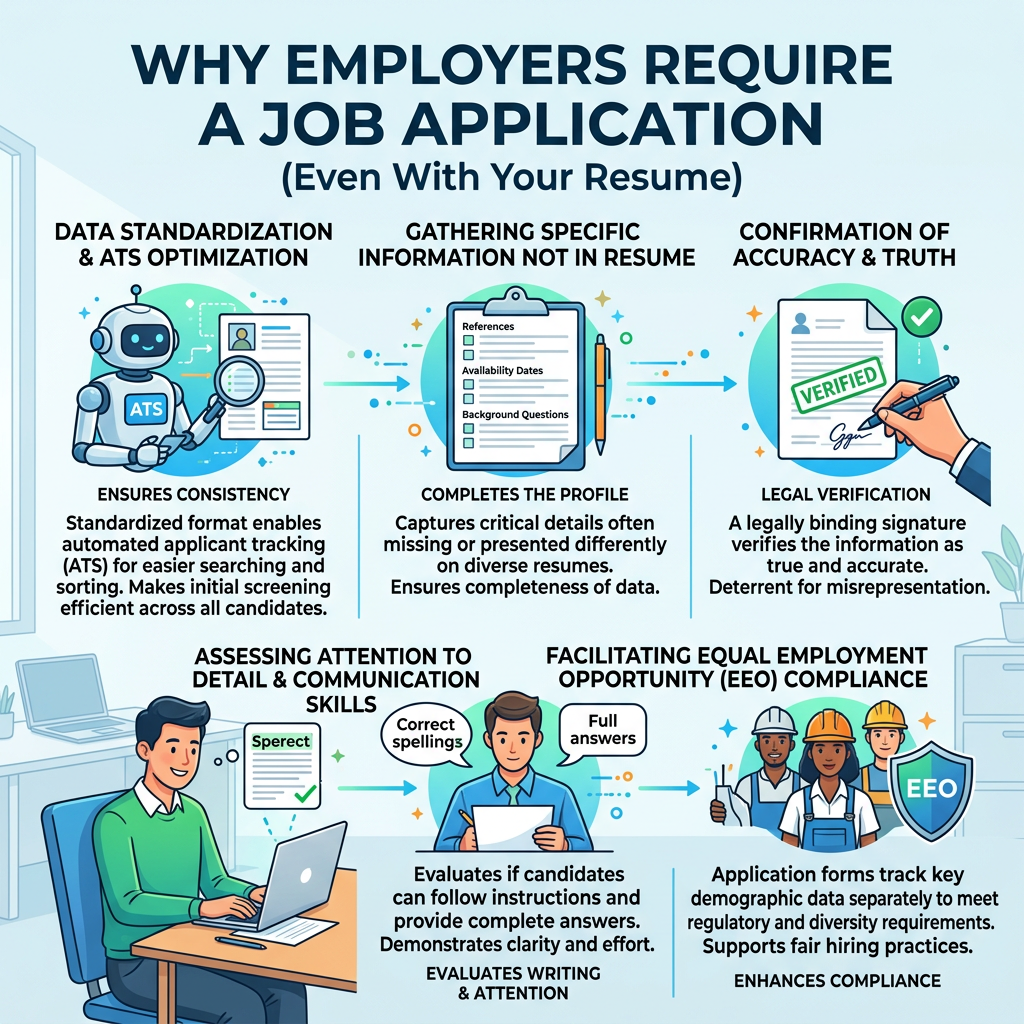
1. A job application gives the employer standardized information
Every resume looks different.
One applicant might list every job they have held for the past 15 years. Another might include only the positions most relevant to the job. One person may include exact employment dates, while another may list only the years.
A job application gives the employer a standardized way to collect information from every applicant.
The application may ask for:
- Previous employers
- Job titles
- Dates of employment
- Education
- Professional licenses or certifications
- Skills and qualifications
- Contact information
- References
- Availability
- Other job-related information
This can make it easier for an employer to compare applicants using the same basic information.
The federal government, for example, uses application materials to collect specific information about an applicant’s experience and qualifications rather than relying solely on a traditional resume.
2. The application may contain information that is not on your resume
A resume is generally designed to highlight your strongest and most relevant qualifications.
A job application may ask for additional information that you would not normally put on a resume.
For example, an employer may ask about:
- Exact employment dates
- Contact information for previous employers
- Whether the employer may contact a current employer
- Professional licenses
- Work availability
- Specific job-related qualifications
- References
- Other information necessary to evaluate your application
The application can therefore fill in gaps that may exist in a resume.
3. Employers may use applications as part of their hiring system
Many employers use applicant tracking systems and other hiring software to collect and organize applications.
The U.S. Department of Labor explains that applicant tracking systems can collect and organize resumes and help employers search for candidates based on qualifications and keywords.
An employer’s online application may therefore be connected to the system it uses to manage candidates.
Instead of having a hiring manager manually compare dozens or hundreds of different resumes, the employer may use the application and its hiring system to organize candidates and move them through the hiring process.
4. The application creates the same starting point for applicants
Resumes can vary significantly in format and content.
An employer could receive:
- A one-page resume
- A five-page resume
- A chronological resume
- A functional resume
- A resume with extensive detail
- A resume with very little detail
Requiring an application gives the employer a common set of information from each applicant.
This can be particularly useful for larger employers that receive a large number of applications.
The Equal Employment Opportunity Commission advises employers to screen applications consistently and apply the same standards to people applying for the same position.
5. The application may contain certifications or statements
Some applications contain statements that go beyond the basic information on a resume.
For example, an application may ask you to certify that the information you provided is accurate and complete.
It may also include statements concerning the employer’s hiring process, references, or other employment-related matters.
That is one reason you should not assume that submitting a resume automatically satisfies an employer’s application requirement.
If the employer says that a completed application is required, the employer may choose not to consider an applicant who does not complete it.
Is a Job Application Legally Required?
There is generally no federal law requiring every employer to use a job application or requiring every applicant to submit one.
Whether an employer requires an application is generally a matter of the employer’s hiring process.
An employer can generally decide that applicants must complete an application before they will be considered for a position.
However, an employer cannot use its application process as a way to discriminate against applicants.
Federal employment discrimination laws prohibit employers from making hiring decisions based on protected characteristics such as race, color, religion, sex, national origin, disability, age 40 or older, or genetic information.
Employers also have restrictions on certain questions they may ask during the hiring process.
For example, the EEOC states that employers generally cannot ask applicants about disabilities before making a job offer, with limited exceptions concerning accommodations and an applicant’s ability to perform the job.
Similarly, employers generally should not ask pre-employment questions that reveal protected characteristics unless there is a legitimate reason permitted by law.
Why Do Employers Ask for Information That Is Already on My Resume?
This is probably the most frustrating part of the process.
You may have already spent an hour creating a resume, only to be asked to type your entire employment history into an online application.
It may seem pointless, but the employer may want the information in a particular format.
For example, your resume might say:
ABC Company — Marketing Manager — 2020–2025
The application might require you to enter:
- Employer name
- Job title
- Start date
- End date
- Job duties
- Supervisor
- Employer contact information
The application therefore gives the employer information in a consistent structure that may be easier to search, store, or evaluate.
It can still be repetitive, but the repetition may serve an administrative purpose.
Do Employers Actually Read Your Resume If You Fill Out an Application?
Sometimes they do, and sometimes the application is used as the primary source of information.
There is no universal rule requiring employers to use one document instead of the other.
Some employers may review the resume first to determine whether a candidate appears qualified. Others may use information from the application and resume together.
The U.S. Equal Employment Opportunity Commission has recognized that employers commonly review applicants’ resumes and other application materials when evaluating qualifications.
This is why it is usually a mistake to treat the application as something you can complete carelessly just because your resume has already been submitted.
What If the Job Application Asks for Something That Isn’t on My Resume?
If the employer requires the information and the question is legitimate, you generally should answer it accurately.
Do not assume that because something is absent from your resume, you can leave it out of the application.
For example, if the application asks for the exact dates you worked for a previous employer, provide the dates as accurately as you can.
If you do not remember an exact date, check your records rather than guessing.
You should also make sure your application and resume do not contradict each other.
An unexplained difference between the two could raise questions about your employment history or qualifications.
The Department of Labor warns applicants for federal positions that false statements, exaggerations, or attempts to conceal information can have serious consequences.
Can an Employer Require You to Complete an Application Before an Interview?
Yes. An employer can generally make completion of an application part of its hiring process.
The employer may require you to submit the application before:
- Reviewing your candidacy
- Scheduling an interview
- Moving you to the next stage of the hiring process
- Making a job offer
The fact that you have already submitted a resume does not necessarily mean the employer has to accept the resume as a substitute for its application.
If the job posting specifically says that a completed application is required, failing to complete it could mean that your application is not considered.
What About Questions About Race, Sex, Age, or Other Personal Information?
This is where applicants should pay attention.
Some employment applications contain separate voluntary demographic questionnaires asking about race, ethnicity, sex, disability, or other demographic information.
These questions can serve legitimate purposes, such as monitoring equal employment opportunity efforts, but information used for applicant-flow or affirmative-action purposes may be required to be kept separate from the selection process. The EEOC has specifically addressed the importance of separating certain demographic information from hiring decisions.
Other questions can raise legal concerns.
For example, before a job offer, employers generally cannot ask applicants questions designed to determine whether they have a disability.
Employers also generally should not ask questions about protected characteristics when those questions are not relevant to determining whether the applicant is qualified for the job.
If an application asks an unusual or potentially discriminatory question, the legal issue depends on what is being asked, why the employer is asking it, and how the information is being used.
Do You Have to Fill Out a Job Application If You Already Submitted a Resume?
If an employer requires an application, you generally should complete it even if you already submitted a resume.
Think of the resume and application as two different parts of the same hiring process.
Your resume is your opportunity to present your experience and qualifications in the way you think best represents you.
The application is the employer’s standardized way of collecting information from applicants.
Yes, there can be significant overlap.
But if you refuse to complete the application because you believe your resume should be enough, the employer may simply move on to another candidate who followed the application instructions.
Bottom Line: Why Employers Require a Job Application
It can absolutely feel redundant to submit a resume and then type the same information into a job application.
But employers generally have legitimate reasons for requiring both. The application can give the employer standardized information, collect details that may not appear on a resume, and fit into the employer’s hiring and applicant-tracking system.
The important thing for job seekers is to complete the application carefully and make sure it is consistent with your resume.
And remember that an employer’s application process is still subject to employment laws. Employers cannot use applications to discriminate against applicants or ask certain prohibited pre-employment questions.
If an employer requires an application, your best approach is usually to treat it as an important part of your application—not as unnecessary paperwork.
For more guidance on finding and applying for jobs, visit our Job Search & Applications page for additional job-search and application tips.
Related Articles
- How to Find Jobs That Aren’t Posted Online
- Illegal Interview Questions: What Employers Cannot Ask You
- What Is Workplace Discrimination?
Disclaimer
This article provides general information about employment and hiring practices in the United States and is intended for educational purposes only. It is not legal advice and does not create an attorney-client relationship. Employment laws can vary by state and may change over time. The information in this article may not apply to your specific situation. If you have questions about your legal rights or a particular employment situation, consider consulting a qualified attorney licensed in your state.
Please read our Terms and Conditions.
Article: Why Employers Require a Job Application When You Already Submitted a Resume
Discover more from Worker Wisdom℠
Subscribe to get the latest posts sent to your email.