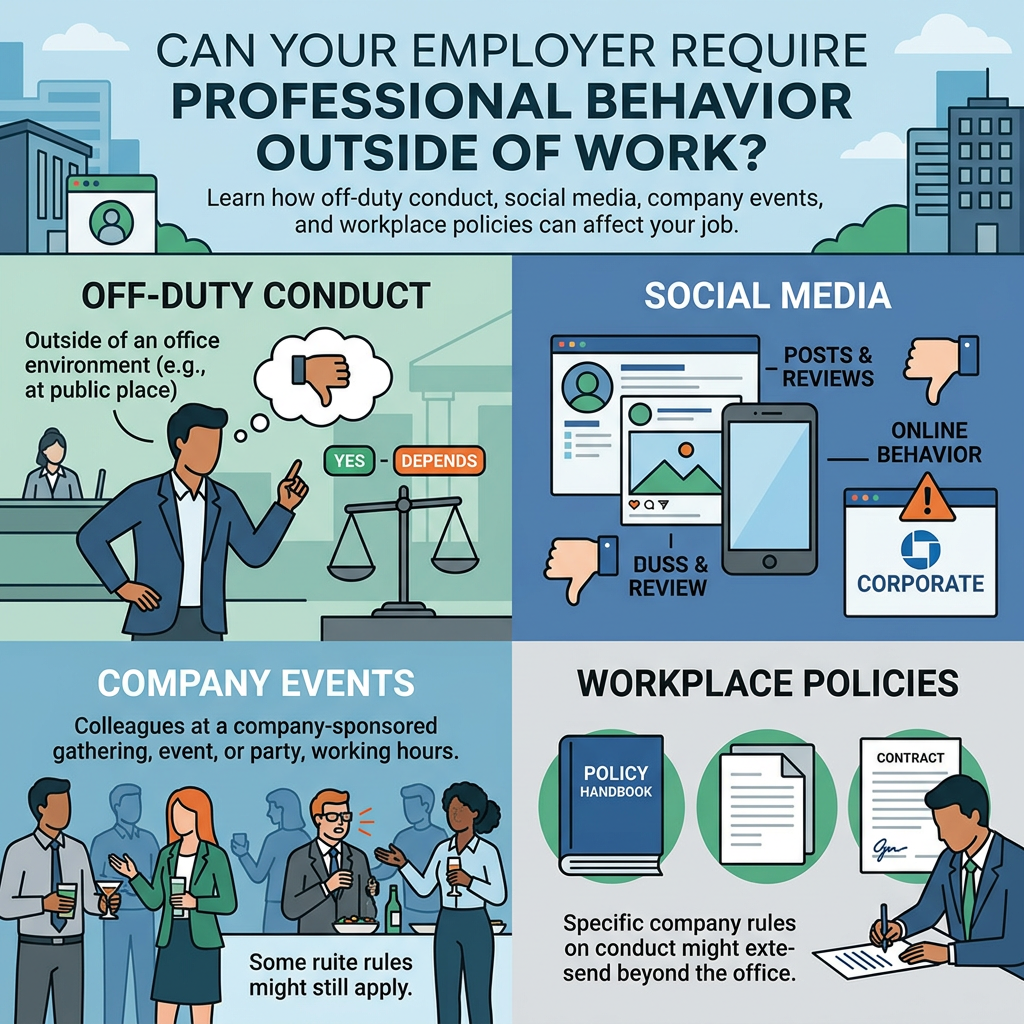

Can Your Employer Require Professional Behavior Outside of Work?
You probably expect your employer to have rules about how you behave at work. But what about when you are off the clock?
Can your employer tell you how to behave at a restaurant? Can you be disciplined for something you post on social media? What if you get into an argument with someone on the weekend? Can your employer require you to maintain a certain level of professionalism even when you are not working?
These questions can be surprisingly complicated.
An employer’s ability to regulate your behavior outside of work depends on the circumstances, the employer’s policies, the connection between the conduct and your job, and the laws that apply where you work.
Some employers have legitimate reasons to be concerned about off-duty conduct, particularly when an employee’s behavior directly affects the workplace, coworkers, customers, or the employer’s business.
But being an employee does not mean that everything you do outside of work is automatically subject to your employer’s control.
This article explains what employees should know about off-duty conduct, social media, employer-sponsored events, and workplace policies.
Table of Contents
Can Your Employer Control What You Do Outside of Work?
Generally, an employer does not have unlimited control over an employee’s private life.
Your employer is not your supervisor 24 hours a day simply because you are employed by the company.
However, some off-duty conduct can have legitimate employment consequences.
For example, an employer may have a reasonable concern if an employee:
- Harasses or threatens a coworker outside of work
- Discloses confidential company information
- Makes statements while representing the company
- Engages in misconduct at an employer-sponsored event
- Uses the employer’s property improperly
- Creates a serious workplace safety issue
- Violates a legitimate workplace policy
- Engages in conduct directly connected to the employee’s job
The closer the conduct is to the employee’s job, the workplace, coworkers, customers, or employer, the more likely it is to become an employment issue.
That does not automatically mean the employer has the legal right to discipline the employee. Other laws and protections may apply.
What Does “Professional Behavior” Mean?
“Professional behavior” can mean very different things depending on the workplace.
An employer may expect employees to:
- Treat coworkers respectfully
- Avoid harassment
- Follow workplace conduct rules
- Protect confidential information
- Avoid conflicts of interest
- Represent the company appropriately when acting on its behalf
- Follow reasonable safety requirements
- Avoid conduct that interferes with their job responsibilities
But a general expectation that employees should “act professionally” does not necessarily give an employer unlimited authority over an employee’s private life.
The more vague a policy is, the more important it may be to look at how the employer actually applies it.
For example, there is a significant difference between a policy prohibiting employees from threatening coworkers and a policy stating that employees must always behave “appropriately” in their personal lives.
The specific language matters.
Can Your Employer Discipline You for Something You Do Off the Clock?
Possibly.
An employer may discipline an employee for certain off-duty conduct, depending on the circumstances and applicable law.
For example, an employee may face workplace consequences if off-duty conduct:
- Directly involves coworkers
- Results in a workplace complaint
- Involves customers or clients
- Reveals confidential information
- Interferes with the employee’s ability to perform the job
- Violates a lawful workplace policy
- Creates a legitimate business or safety concern
- Occurs while the employee is representing the employer
But an employer’s ability to discipline an employee for off-duty conduct can vary considerably by state.
Some states have laws that provide employees with additional protections for lawful conduct outside of work.
Other states provide fewer protections, particularly for employees who are employed at will.
That is why an answer based solely on the phrase “at-will employment” is not enough.
Does At-Will Employment Mean Your Employer Can Fire You for Anything You Do?
No.
At-will employment does not mean that an employer can legally fire an employee for absolutely any reason.
Even in an at-will employment relationship, an employer cannot take employment action for a reason prohibited by applicable law.
For example, federal law prohibits employment discrimination based on protected characteristics covered by federal anti-discrimination laws. It also prohibits retaliation for certain protected activities, such as opposing unlawful discrimination or participating in an employment discrimination proceeding.
Other federal, state, and local laws may provide additional protections.
Therefore, the question is not simply whether your employer can fire you.
The more important question is why the employer is taking the action and whether another law protects the employee’s conduct.
Can Your Employer Monitor Your Social Media?
Social media creates some of the most common questions about off-duty behavior.
Employees often assume that something posted from a personal account is automatically private because it was posted outside of work.
That is not necessarily how employers view social media.
If a post is public, an employer may become aware of it. An employer may also have policies addressing social media use and conduct.
However, employers cannot simply create a social media policy that overrides employees’ legal rights.
For example, the National Labor Relations Board explains that employees have the right to engage in certain protected concerted activity involving wages, benefits, and working conditions, including through social media.
This protection can apply even when employees are not represented by a union.
Can You Be Fired for Complaining About Your Job on Social Media?
Not necessarily.
This is an area where employees need to be careful about assuming that every social media complaint is either protected or unprotected.
The National Labor Relations Act protects certain concerted activity.
For example, employees may have protection when they act together with coworkers—or seek to initiate or prepare for group action—to address issues such as wages, benefits, hours, or working conditions.
The NLRB specifically recognizes that social media can be a place where employees engage in protected concerted activity.
However, not every complaint about an employer is protected.
An employee who is simply complaining individually about work is not automatically engaging in protected concerted activity. The circumstances and nature of the communication matter.
Certain misconduct can also affect whether otherwise protected activity remains protected.
Because social media cases can be highly fact-specific, employees should not assume that a particular post is either automatically protected or automatically grounds for termination.
Can Your Employer Punish You for a Political Post?
This is another area where the answer can vary significantly.
Whether an employer can discipline an employee over political speech or political activity can depend on factors including:
- Where the employee works
- Whether the employer is private or governmental
- State and local laws
- Whether the conduct occurred at work
- Whether the employee was speaking on behalf of the employer
- Whether the employee’s conduct violated another lawful workplace rule
- Whether another legally protected activity is involved
Private-sector employees generally do not have the same First Amendment protections against their private employers that they have against government action.
However, that does not mean a private employer can always discipline an employee for political activity. State and local laws may provide additional protections, and other employment laws may become relevant depending on the circumstances.
This is one reason employees should check the law that applies in their particular location rather than relying on a general statement about “free speech.”
Can Your Employer Discipline You for Getting Arrested?
An arrest is not necessarily the same thing as a conviction.
Whether an employer can take action because an employee was arrested can depend on the circumstances, the employee’s job, the employer’s policies, state law, and what actually happened.
For some positions, an arrest or criminal allegation may have a direct connection to job responsibilities or licensing requirements.
For other employees, an off-duty incident may have little or no connection to their work.
Employers should also be careful when making employment decisions based on criminal history because federal and state laws can impose restrictions on how criminal-record information is considered in employment decisions.
If an employer disciplines you because of an arrest, the reason for the decision and the laws applicable to your situation may matter.
Can Your Employer Fire You for Getting Into a Fight Off the Clock?
Possibly, but the circumstances matter.
Consider two very different situations.
In the first, an employee gets into a personal dispute with a stranger at a location completely unrelated to work.
In the second, an employee gets into a fight with a coworker at a restaurant and the incident creates an ongoing workplace conflict.
The employer’s concerns are likely to be very different in those situations.
The employer may have a stronger argument for workplace discipline when off-duty conduct directly affects coworkers, workplace safety, or the employee’s ability to perform the job.
But even then, applicable state law and the employer’s policies still matter.
What If the Off-Duty Conduct Involves a Coworker?
Off-duty conduct involving coworkers can become particularly complicated.
Employees sometimes socialize outside of work, attend parties together, date coworkers, or have personal disagreements.
A disagreement between two employees does not automatically become a workplace matter simply because both people work for the same employer.
However, the situation can become relevant to the employer if it:
- Carries over into the workplace
- Creates threats or harassment
- Affects workplace safety
- Interferes with job performance
- Creates a hostile work environment
- Involves misuse of company resources
- Violates a legitimate workplace policy
An employer may have a legitimate reason to address conduct that begins outside the workplace but creates an actual workplace problem.
Can Your Employer Require Professional Behavior at a Company Party?
This depends on the circumstances.
A company-sponsored event may still be connected to employment even if it takes place outside normal working hours.
For example, an employer may reasonably establish expectations concerning harassment, threats, violence, discrimination, or other misconduct at an employer-sponsored event.
The fact that employees are technically “off the clock” does not necessarily mean that every workplace rule disappears.
This is particularly important when the employer is hosting or sponsoring the event and employees are attending as part of their employment.
However, an employer’s authority is still subject to applicable law.
Being invited to a company party does not automatically give an employer unlimited control over everything an employee does that evening.
Can an Employer Require Employees to Behave Professionally on Social Media?
An employer may establish certain social media policies, but the policy must still comply with applicable law.
A particularly important issue involves policies that are so broad that they restrict employees from exercising legally protected rights.
The NLRB has explained that employees have rights to discuss wages, benefits, and working conditions with coworkers, including through social media.
The NLRB has also challenged workplace policies that were overly broad and interfered with employees’ protected concerted activity.
So a policy telling employees not to disclose confidential customer information may raise different legal questions from a policy that broadly prohibits employees from making any negative comments about their employer.
The exact wording matters.
What If Your Employee Handbook Has an Off-Duty Conduct Policy?
Your employee handbook may contain a policy addressing employee behavior outside the workplace.
Look carefully at the language.
Some policies may specifically address:
- Social media
- Public statements
- Confidentiality
- Criminal conduct
- Conflicts of interest
- Relationships with customers
- Conduct involving coworkers
- Employer-sponsored events
- Use of the employer’s name
- Representation of the company
If you are concerned about a particular rule, read the entire policy rather than relying on a single sentence.
Also check whether the handbook says that policies may be changed and whether it contains an acknowledgment or disclaimer.
Your employee handbook is only one part of the legal picture, but it can help show what your employer expects from employees.
For more information about workplace policies and the rules employers may establish, see our Workplace Rules & Policies guide.
Can an Employer Enforce the Same Rule Against Some Employees but Not Others?
Employers generally need to be careful about applying workplace rules inconsistently.
Suppose two employees engage in similar off-duty conduct, but the employer disciplines one employee and ignores the other.
That does not automatically make the discipline illegal. There may be legitimate reasons for treating the situations differently.
However, inconsistent treatment can become important when an employee alleges discrimination or retaliation.
The EEOC advises employers to consider whether they are treating employees differently from other employees who have violated similar rules, particularly when an employee has engaged in protected activity.
If you believe you were singled out for off-duty conduct while other employees were treated differently, document the differences and consider whether another legal issue may be involved.
Can Your Employer Require You to Protect Its Reputation?
Employers have legitimate interests in protecting confidential information, customer relationships, and business operations.
But a broad demand that employees “protect the company’s reputation” does not necessarily give an employer unlimited control over employees’ personal speech.
For example, a policy addressing the disclosure of confidential business information is different from a policy that broadly prohibits employees from discussing workplace problems.
Employees have legal protections concerning certain workplace complaints and collective activity.
The NLRB specifically recognizes employees’ rights to act together concerning wages, benefits, and working conditions.
An employer therefore needs to distinguish between legitimate protection of its business interests and restrictions that interfere with employees’ legal rights.
What If Your Employer Says Your Off-Duty Conduct Makes the Company Look Bad?
An employer may consider reputational concerns when making an employment decision, but that does not automatically make every decision lawful.
The circumstances matter.
Questions to consider include:
- What exactly did the employee do?
- Was the employee acting as a representative of the company?
- Was the employee wearing a company uniform?
- Was the employee attending a company-sponsored event?
- Did the conduct involve coworkers or customers?
- Did the employee disclose confidential information?
- Did the conduct affect the workplace?
- Did the employee violate a specific workplace policy?
- Are there state laws protecting the conduct?
- Were other employees treated similarly?
A vague statement that an employee “embarrassed the company” does not answer these questions.
The employer’s actual reason for taking action can be important.
What Should You Do If Your Employer Disciplines You for Off-Duty Conduct?
If your employer threatens discipline or fires you because of something you did outside of work, start by documenting exactly what happened.
Save:
- The relevant employee handbook
- The applicable workplace policy
- Emails from your employer
- Text messages
- Disciplinary notices
- Social media posts involved in the dispute
- Messages with coworkers
- Information about who was involved
- Evidence showing how similar situations were handled
Then review the policy your employer claims you violated.
Ask yourself:
Was the conduct actually covered by the policy?
A policy may be narrower than the employer’s explanation suggests.
Was the conduct connected to my job?
The relationship between the conduct and the workplace can matter.
Was I engaged in legally protected activity?
For example, certain discussions with coworkers about wages or working conditions may be protected under federal labor law.
Were other employees treated differently?
Inconsistent treatment can be important, particularly when discrimination or retaliation may be involved.
Does my state provide additional protections?
State law can make a significant difference in off-duty conduct cases.
Does Your Employer Have the Right to Know What You Do Off the Clock?
Not necessarily.
An employer does not automatically have a right to know everything an employee does during personal time.
However, an employer may have a legitimate reason to investigate conduct that potentially affects the workplace or violates a lawful workplace policy.
For example, an employer may investigate allegations that an employee threatened a coworker outside work if the incident creates a workplace safety concern.
That is different from an employer demanding information about every aspect of an employee’s private life simply because the employee works for the company.
The scope of an employer’s authority can depend heavily on the circumstances and applicable law.
Does This Apply to Every Employee?
No.
Different legal rules can apply depending on the type of employer and the employee’s position.
For example, public-sector employees can have constitutional rights that private-sector employees generally do not have.
Certain highly regulated professions may also be subject to professional licensing requirements or industry-specific rules.
Unionized employees may have collective bargaining agreements that affect discipline and workplace rules.
Employees covered by employment contracts may also have different rights from employees working at will.
These distinctions are important when evaluating an employer’s response to off-duty conduct.
When Should You Talk to an Employment Attorney?
Consider getting legal advice if your employer takes serious action against you because of something that happened outside of work, particularly if:
- You were fired
- You were suspended
- Your pay or position was affected
- The employer claims you violated a handbook policy
- You believe the rule is being applied selectively
- You believe discrimination is involved
- You believe retaliation is involved
- You believe you were punished for discussing workplace conditions with coworkers
- Your state has specific off-duty conduct protections
- The incident involves a contract, collective bargaining agreement, or professional license
An employment attorney can evaluate the specific facts and determine which laws may apply.
So, Can Your Employer Require Professional Behavior Outside of Work?
Whether an employer can require you to behave professionally outside of work depends on what you did, how closely it relates to your employment, what your employer’s policies say, and what laws protect you.
An employer may have legitimate reasons to regulate certain off-duty conduct, particularly when it affects coworkers, customers, workplace safety, confidential information, or the employer’s business.
But an employer does not automatically have unlimited control over an employee’s private life.
Social media, political activity, off-duty relationships, criminal allegations, and personal disputes can all raise different legal questions. Federal law also protects certain employee activity outside the traditional workplace, including some concerted discussions about wages, benefits, and working conditions.
If your employer disciplines you for something you did outside of work, don’t assume that the employer was automatically right—or automatically wrong.
Look at the specific policy, what actually happened, how the employer has treated similar situations, and the laws that apply where you work.
For more information about workplace policies and employee protections, visit our Workplace Rules & Policies and Employee Rights guides.
Related Articles
- Are Employee Handbooks Legally Binding?
- Can Your Boss Yell at You?
- Can Your Employer Make You Work on Your Day Off?
- Can Your Employer Make You Work Through Lunch?
Disclaimer
This article provides general information about employment law and is not legal advice. Employment laws vary by state, and the law that applies to your situation may depend on the specific facts. If you have a specific legal concern about your employment, consider consulting a qualified employment attorney. Please read our Terms and Conditions.
Article: Can Your Employer Require Professional Behavior Outside of Work?
Discover more from Worker Wisdom℠
Subscribe to get the latest posts sent to your email.