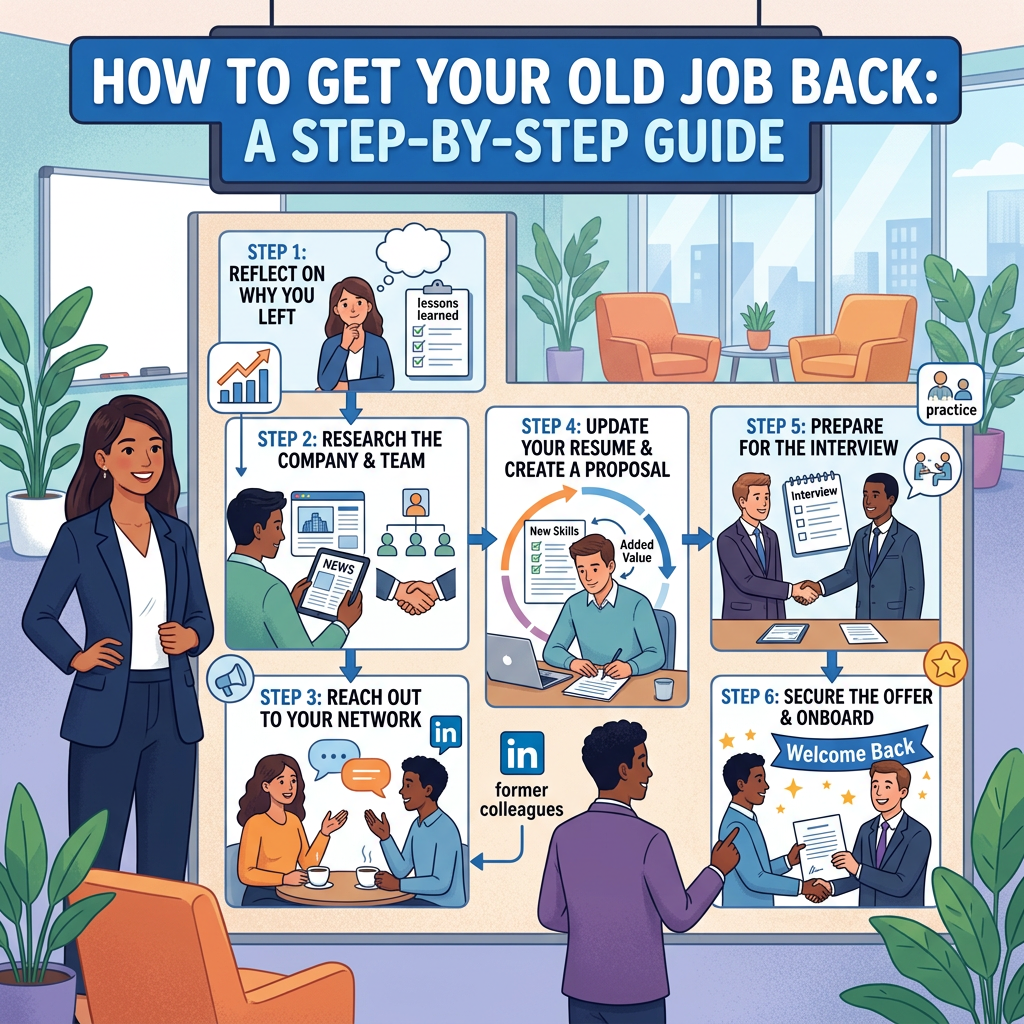

How to Get Your Old Job Back: A Step-by-Step Guide
Updated: 9/3/26
Regretting a job change can be an uncomfortable feeling.
Maybe you left your old job for a new opportunity that looked better on paper. Maybe the new company isn’t what you expected. Maybe you miss your coworkers, your manager, the flexibility, or simply the work you were doing.
Or maybe you left for a completely legitimate reason, but circumstances have changed and you now realize that your old job was a better fit.
Whatever happened, you may be wondering:
Can I get my old job back?
You can certainly ask.
There is no guarantee your former employer will rehire you, and you may not get the exact position, salary, or benefits you had before. But if you left on reasonably good terms, you may have an advantage over an outside applicant because the company already knows your work, your experience, and what you can contribute.
The key is to approach your former employer thoughtfully and give them a reason to want you back.
Table of Contents
Can You Really Get Your Old Job Back?
Yes. Former employees can be rehired.
There is generally nothing that prevents you from contacting a former employer and asking whether there is an opportunity to return.
Whether the company actually hires you is another question.
Your former employer may have:
- Filled your old position
- Eliminated the position
- Changed the department
- Changed management
- Adopted a different hiring policy
- Decided not to rehire former employees
- Considered you ineligible for rehire
- Changed the job substantially since you left
The circumstances surrounding your departure can also matter.
Someone who resigned professionally after giving notice may have a very different experience from someone who was fired for serious misconduct.
The good news is that you won’t know unless you ask.
Should You Go Back to Your Old Job?
Before contacting your former employer, make sure you actually want to go back.
It is easy to romanticize an old job after starting a difficult new one.
You might remember the good parts of your previous job while forgetting why you wanted to leave.
Ask yourself:
- Why did I leave?
- What did I dislike about the job?
- Has that problem changed?
- Is my old manager still there?
- Has the company changed?
- Would I have the same responsibilities?
- Would I be earning enough?
- Would I have the same schedule?
- Would I still have the flexibility I valued?
- Am I going back because I genuinely want the job or because I hate my current job?
- Would returning help my career?
- Would I be happy there six months from now?
One particularly useful question is:
If I had never accepted my new job, would I still want my old job?
If the answer is yes, returning may be worth pursuing.
Why Do People Want Their Old Jobs Back?
There are many legitimate reasons someone may want to return to a former employer.
You may have discovered that:
- The new job is not what you were promised.
- Your new workplace has a poor culture.
- Your former company offered better work-life balance.
- You miss your former coworkers.
- You had a better relationship with your previous manager.
- The commute at your new job is worse.
- Your previous job offered better flexibility or remote work.
- You prefer the work you were doing before.
- Your new employer does not offer the career growth you expected.
- Your personal circumstances have changed.
- You left for more money but discovered that compensation wasn’t the only thing that mattered.
Wanting to return does not necessarily mean you made a terrible career decision.
Sometimes you need to experience something different to understand what you actually value in a job.
Think Carefully About Why You Left
This is one of the most important parts of the process.
If you left because your boss was difficult, the company was disorganized, the workload was unreasonable, or you were unhappy with the culture, find out whether anything has changed.
If nothing has changed, going back may simply recreate the same problem.
On the other hand, some reasons for leaving disappear over time.
Perhaps your manager has left.
Maybe the company changed its policies.
Maybe the position has been redesigned.
Maybe you have developed new skills that would allow you to return in a more senior role.
Don’t simply ask, “Do I miss my old job?”
Ask:
“Would my old job still be a good job for me today?”
Check Whether Your Old Position Is Still Available
Before reaching out, check the company’s website and current job postings.
If your former position is advertised, that’s useful information.
You can apply through the normal process and also reach out to your former manager or another appropriate contact.
But don’t assume you need to find the exact same job.
There may be another opening that is an even better fit.
Your former employer may have a position that uses the experience you gained after leaving.
Find Out Whether You Are Eligible for Rehire
Some employers have formal rehire policies.
Your former employer may have information in its HR system indicating whether you are eligible for rehire.
Your eligibility may depend on circumstances such as:
- How you left
- Whether you gave notice
- Whether you completed your notice period
- Your performance
- Whether you were terminated
- Whether there was serious misconduct
- Whether you violated company policies
- The employer’s rehire policy
There is no universal rule requiring a private employer to rehire a former employee.
If you’re unsure about your status, you can still ask.
Leaving on Good Terms Helps
If you resigned professionally, you may already have an important advantage.
Your former employer knows you.
They may know:
- How you perform
- Whether you meet deadlines
- How you work with coworkers
- Whether you can be trusted
- What your strengths are
- How much training you need
- What you accomplished while working there
That can make returning easier than starting from scratch with a company that knows nothing about you.
Your professional relationships can also matter. Staying connected with former coworkers and managers can make it easier to learn about opportunities when they arise.
What If You Left on Bad Terms?
You can still ask, but be realistic.
If you quit without notice, had serious conflicts with management, or were terminated, the company may have reservations about bringing you back.
Don’t try to rewrite history.
If you made a mistake, taking responsibility may be more effective than making excuses.
You might explain that you’ve reflected on how you handled the situation and that you would approach things differently today.
But if your former employer isn’t interested, respect the decision.
What If You Were Fired?
Being fired does not necessarily mean you can never work for the company again.
However, the reason for the termination can be extremely important.
A former employer may be more willing to reconsider someone who was terminated because of circumstances that have changed than someone who was fired for serious misconduct.
If you were fired for performance problems, be prepared to explain what has changed.
For example, perhaps you’ve gained additional training, experience, or skills since leaving.
If the termination involved serious misconduct, however, you should have realistic expectations.
What If You Quit Without Giving Two Weeks’ Notice?
This can make returning more difficult, but it does not necessarily make it impossible.
Your former employer may consider how you left when deciding whether to rehire you.
If you want another opportunity, don’t spend your conversation blaming everyone else.
Acknowledge what happened.
Explain what you learned.
Then focus on what you can offer the company now.
How Should You Contact Your Former Employer?
In many cases, email is a good place to start.
It gives you an opportunity to explain why you’re reaching out without putting your former manager on the spot.
It also gives you a written way to reconnect.
If you had a particularly strong relationship with your former manager, you could also call or send a professional message first.
The best person to contact depends on your circumstances.
Consider:
- Your former manager
- The current manager of your former department
- A hiring manager
- An HR representative
- A former coworker who can point you in the right direction
If your former manager is no longer with the company, don’t let that stop you.
What Should You Say When Asking for Your Old Job Back?
Keep your message positive and professional.
You don’t need to write a long explanation about how miserable you are in your current job.
Instead, explain why you are interested in returning and what you can bring to the company.
A strong message might look like this:
“I hope you’re doing well. I’ve been thinking about my time at the company and wanted to reach out. Since leaving, I’ve gained additional experience in [area], and I’ve realized how much I valued the work and team. I’d be very interested in discussing whether there may be an opportunity for me to return. If you’re open to it, I’d love to reconnect and discuss any opportunities that may be available.”
Notice what this does not say.
It doesn’t say:
- “I made a huge mistake.”
- “My new company is horrible.”
- “I need my job back.”
- “I’ll take anything.”
- “Can you hire me immediately?”
You’re opening a professional conversation.
Should You Explain Why You Left?
Yes—but keep it honest and concise.
Your former employer is likely to wonder why you left and why you now want to return.
You don’t need to hide the fact that you wanted a different opportunity.
For example:
If you left for a better opportunity:
Explain that you wanted to expand your experience and have since realized that your former company was a particularly good fit.
If you left for more money:
You can acknowledge that compensation was an important factor while explaining what you’ve learned about the overall value of the job.
If you left because you wanted career growth:
Explain what you learned and how your goals have evolved.
If you left for personal reasons:
You can explain that your circumstances have changed without providing unnecessary personal details.
The goal is to demonstrate that your decision to return is thoughtful.
Don’t Badmouth Your Current Employer
This is one of the easiest mistakes to make.
Even if your current employer is the reason you want to return, don’t turn your conversation into a complaint session.
Your former employer may wonder:
“Will this person eventually talk about us the same way?”
Instead, focus on what you appreciated about your former workplace and what you have learned since leaving.
Keep the conversation about why the old job is a good fit, not why the new job is terrible.
Tell Them What Has Changed
This is where you can make your case much stronger.
If you have been away for six months or two years, you should be able to identify what you bring to the table now.
Maybe you have:
- Learned new software
- Managed a larger team
- Earned a certification
- Taken on more responsibility
- Developed new technical skills
- Worked with different customers
- Learned a new industry
- Improved your leadership skills
- Gained experience your former employer needs
Don’t simply say:
“I want to come back.”
Give the employer a reason to think:
“This could actually be good for us.”
What If Your Old Job Is Already Filled?
Don’t assume that means the conversation is over.
Ask whether there are other opportunities.
You may be able to return in:
- A similar position
- A different department
- A more senior role
- A newly created position
- A position that wasn’t available when you left
You can also tell the company that you’d like to be considered for future openings.
What If Your Former Employer Says They’d Like You Back?
That’s great—but don’t immediately say yes.
Treat the opportunity like any other job offer.
Find out:
- What is the salary?
- What are the hours?
- Who will you report to?
- Is the job still the same?
- Is the position remote, hybrid, or in-office?
- What benefits are available?
- How much paid time off will you receive?
- Has the company changed its policies?
- Are you being offered your old position or a different one?
- Will your previous years of service count for anything?
- Will you be considered a new employee?
- Are there any new employment agreements you must sign?
Companies change, and your old job may not be the same job you remember.
Can You Negotiate Your Salary When Returning?
Yes.
Don’t assume that returning means accepting your old salary.
Your market value may have changed since you left.
You may also have gained valuable experience elsewhere.
Before accepting the offer, research what similar positions are paying and consider the total compensation package—not just base salary.
You can also negotiate other terms, such as:
- Vacation
- Work schedule
- Remote work
- Job title
- Bonus
- Start date
- Responsibilities
Your former employer may be willing to negotiate because you already understand the company and can potentially become productive quickly.
What If They Offer You Less Than You Made Before?
Don’t assume you have to accept it.
Ask why the compensation is different.
The company may have changed its salary structure, or the position may now have different responsibilities.
You can decide whether the entire package makes sense for you.
If the employer is unwilling to meet your expectations, you can politely decline.
Could You Be Treated Like a New Employee?
Possibly.
Returning to a former employer does not necessarily mean you automatically regain your previous seniority, benefits, vacation accrual, or other employment terms.
The employer’s policies and the terms of your new offer matter.
Ask before accepting.
If something is important to you, don’t rely on an assumption based on what happened during your previous employment.
Get the important terms in writing.
Should You Tell Your Current Employer You’re Trying to Get Your Old Job Back?
Usually, there’s no reason to tell your current employer while you’re merely exploring the possibility.
First find out whether your former employer is interested.
Then evaluate any actual offer.
If you ultimately decide to leave your current job, follow the appropriate resignation process. Worker Wisdom’s Leaving a Job hub covers issues involving resignations, notice, final pay, references, and other issues that can arise when employment ends.
Don’t Quit Your Current Job Based on a Promise
This is important.
Don’t resign from your current job because a former manager says:
“We’d love to have you back.”
Wait until you understand exactly what the employer is offering.
Ideally, have the important terms of the new position in writing before you give notice to your current employer.
A conversation is not the same thing as a job offer.
And a job offer is not necessarily the same thing as an employment contract. The language and circumstances matter. Worker Wisdom’s Hiring & Careers Hub provides additional information about job offers and employment agreements.
What If You Signed an Agreement When You Left?
Review it before returning.
If you signed a separation agreement, severance agreement, confidentiality agreement, non-compete, or another document when you left, it may contain terms that remain relevant after your employment ends.
Don’t assume that being rehired automatically cancels or changes those obligations.
If the agreement contains significant restrictions or you’re unsure about your rights, consider having the document reviewed by an employment attorney.
What If You Had a Legal Dispute With Your Former Employer?
This situation deserves additional caution.
If you previously complained about discrimination, participated in an investigation, filed a discrimination charge, requested an accommodation, or engaged in other legally protected activity, your former employer may still have obligations under applicable anti-retaliation laws.
The Equal Employment Opportunity Commission explains that federal anti-retaliation protections can apply to former employees as well as current employees and applicants.
That doesn’t mean a former employer must rehire you.
It does mean that the reason for a hiring decision can matter if you believe you are being denied employment because you engaged in legally protected activity.
If your previous employment ended amid a serious legal dispute, consider getting legal advice before signing a new agreement or making important decisions.
What If You Left Because of Discrimination or Harassment?
If discrimination or harassment played a role in your departure, don’t treat the situation as an ordinary career decision.
You may want your old job back, but you may also have legal rights or deadlines that have nothing to do with whether the employer is willing to rehire you.
Keep records of relevant communications and consider getting legal advice if you believe unlawful discrimination, harassment, or retaliation occurred.
What If Your Former Employer Says No?
Don’t burn the bridge.
Thank them for considering you.
You can let them know that you’d appreciate being considered for future opportunities.
A “no” today does not necessarily mean “no” forever.
The company may have no opening right now. Your former manager may leave. A new position may become available.
Leave the conversation professionally.
What If Your Former Employer Doesn’t Respond?
Give them some time.
If you don’t receive a response, one polite follow-up is reasonable.
After that, let it go.
Repeated emails or messages are unlikely to improve your chances.
Continue your job search while leaving the door open.
How Long Should You Wait Before Asking for Your Old Job Back?
There is no universal waiting period.
You could reach out shortly after leaving if you quickly realize the new position isn’t right.
You could also return years later.
The longer you have been away, however, the more likely it is that the company, management, job responsibilities, or hiring needs have changed.
That isn’t necessarily a disadvantage.
Your experience since leaving may actually make you a stronger candidate.
Can Returning to an Old Employer Be Good for Your Career?
Absolutely.
Going back to a former employer is not automatically a step backward.
Sometimes returning makes sense because you’ve gained new experience and now have a clearer understanding of what you want.
The question isn’t whether returning looks good or bad.
The question is:
Does returning make sense for your career now?
If the answer is yes, there is nothing inherently wrong with going back.
10 Steps to Get Your Old Job Back
If you are serious about returning, use this checklist:
1. Figure out why you want to return.
Make sure you’re not simply reacting to a bad week at your new job.
2. Revisit why you left.
Determine whether the problems that caused you to leave still exist.
3. Research the company.
Find out what has changed since you left.
4. Look for current openings.
Your old position may still exist—or another position may be available.
5. Reconnect with former colleagues.
Professional relationships can help you understand what is happening at the company.
6. Contact the right person.
Your former manager, hiring manager, or HR may be the appropriate contact.
7. Explain why you’re interested.
Keep the explanation positive, honest, and concise.
8. Show what you’ve gained.
Explain how your experience since leaving makes you an even stronger candidate.
9. Prepare to interview.
Don’t assume the company will automatically give you your old position.
10. Evaluate the offer carefully.
Make sure the job you’re returning to is actually the job you want.
A Simple Email Asking for Your Old Job Back
If you want to reach out by email, you can keep it relatively short.
The goal isn’t to tell your entire career story. It’s to reopen the relationship and start a conversation.
A professional email could look like this:
Subject: Exploring an Opportunity to Return
Hi [Name],
I hope you’re doing well. I’ve been thinking about my time at [Company] and wanted to reach out.
Since leaving, I’ve gained additional experience in [area], and I’ve realized how much I valued the work, team, and culture at [Company]. I’d be very interested in exploring whether there may be an opportunity for me to return.
If you’re open to it, I’d love to reconnect and discuss any opportunities that may be available.
Thank you,
[Your Name]
What Not to Say When Asking for Your Old Job Back
Avoid messages that sound desperate, angry, or impulsive.
Don’t write:
- “I hate my new job.”
- “I made the biggest mistake of my life.”
- “I need my job back.”
- “I’ll take whatever you can give me.”
- “You guys were so much better than my current employer.”
- “I knew leaving was a mistake.”
- “Please give me another chance.”
Even if some of those statements are true, they don’t make the strongest professional impression.
Instead, communicate confidence, maturity, and genuine interest.
The Bottom Line
If you regret leaving your job, you are not necessarily stuck with the decision.
You can ask for your old job back.
The best approach is to first determine whether returning really makes sense. Think carefully about why you left, whether those circumstances have changed, and what you have learned since then.
Then reconnect with your former employer professionally.
Don’t focus entirely on what you miss.
Show the employer what you can bring back to the company.
And if you receive an offer, don’t automatically accept it simply because it feels familiar. Evaluate the salary, benefits, responsibilities, manager, schedule, work location, and career opportunities just as carefully as you would with any other job.
Sometimes going back is exactly the right decision.
Sometimes it confirms why you left in the first place.
Either way, approaching the situation thoughtfully can help you make a better career decision.
Related Articles
- Leaving a Job
- Hiring & Careers
- At-Will Employment: When “At-Will” Really Isn’t
- 10 Hidden Employment Contract Clauses You Should Know
- Can a Company Withdraw a Job Offer?
Disclaimer
This article is intended for informational purposes only and is not intended and should not be construed as professional advice. Employment laws vary by state and situation. The information in this article may not apply to your particular circumstances. If you have a specific employment or legal question, consider consulting an appropriately licensed professional.
Please read our Terms and Conditions.
Discover more from Worker Wisdom℠
Subscribe to get the latest posts sent to your email.